AI Revolution Accelerates: US Army Deploys Large-Scale Agents, Samsung Unveils Memory Roadmap, and Retailers Embed End-to-End AI
Today, August 08, 2026, marks another massive day of acceleration in the artificial intelligence sector as global institutions transition from software experiments to deep infrastructure integration.
Public Sector and Defense Lead the Charge
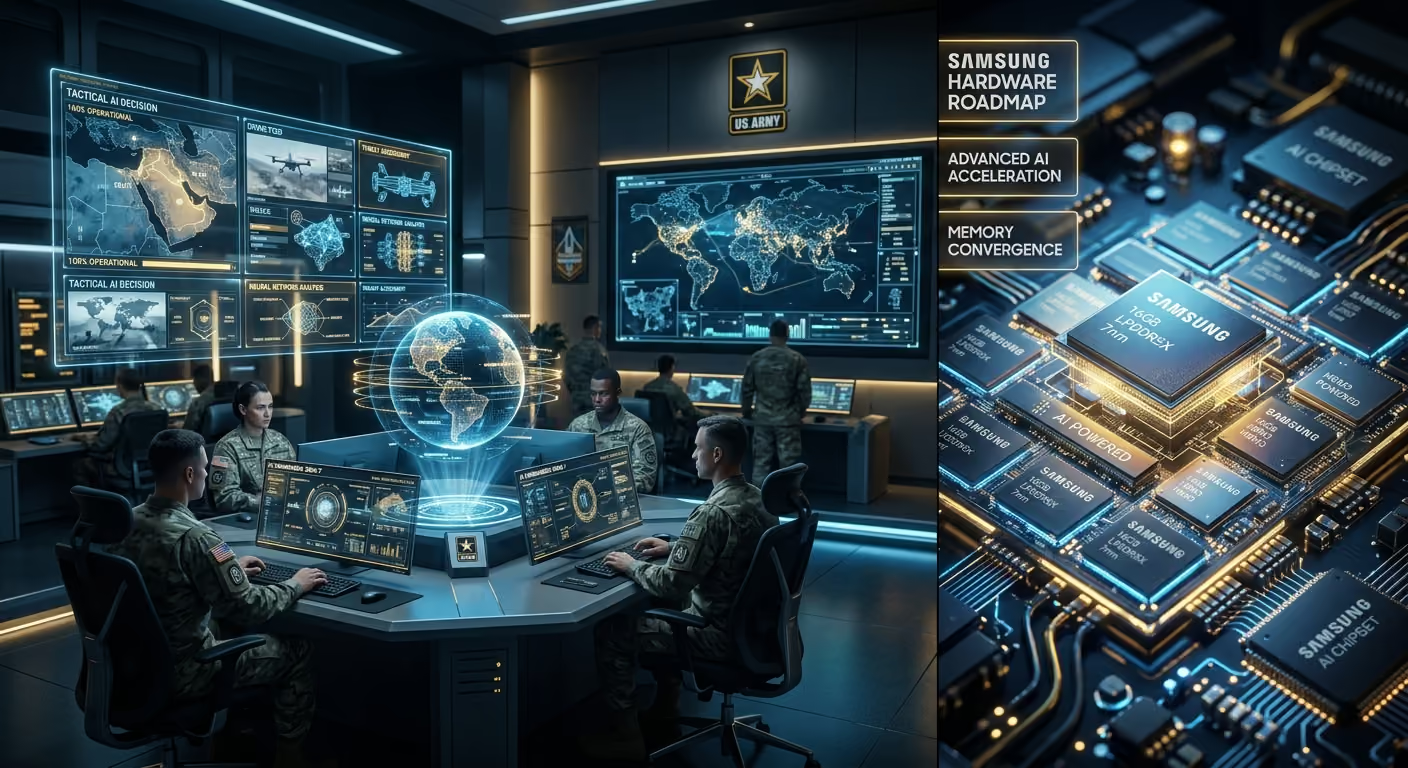
In one of the largest public-sector deployments of intelligent agents to date, the US Army has officially enlisted AI agents to serve 9.2 million soldiers, veterans, and their families. This sweeping initiative aims to streamline complex logistical operations, automate veteran services, and provide continuous administrative support. Simultaneously, Indonesia's National Research and Innovation Agency (BRIN) has announced a strategic shift in focus, pivoting its research programs from nuclear technology toward core AI development to bolster national scientific capabilities.
Next-Generation Hardware and Regional AI Hubs
To sustain the heavy compute demands of modern foundation models, Samsung has officially unveiled its future AI memory roadmap. The semiconductor leader highlighted new architectures designed to eliminate memory bottlenecks in high-performance computing centers. On the regional development front, Pax Silica has set a ambitious three-to-five-year timeline for its massive AI hub project, establishing a long-term foundation for local tech incubation.
Enterprise and Retail Transformation
Global commerce is rapidly adapting to an AI-first reality. South Korean e-commerce giant Coupang has deeply embedded AI across the entire shopping journey, ranging from real-time product comparisons to automatic review summaries. Additionally, S4 Capital's Monks Technology Services has expanded its market presence through the newly launched Watts AI Initiative, aiming to scale custom enterprise solutions.
On the physical innovation front, automotive manufacturers are embracing "embodied AI" at an unprecedented rate. According to reports from the 2026 8th Golden Gear Awards and the China Automotive Industry Innovation Case Database, AI is quickly moving beyond digital screens into physical robotic systems and self-driving vehicular frameworks.
Cultural and Educational Integration
As AI reshapes industry, educational institutions are adapting. In Nebraska, schools are rolling out new frameworks to prepare young learners for an AI-driven workforce, matching initiatives like McAllen ISD's TECHnovate conference, which explores the active intersection of technology and classroom learning.
Meanwhile, the cultural impact of AI is generating heavy debate. Rapper Fenix Flexin recently confirmed that he utilized AI tools to construct his viral hit "Rubberz," reigniting conversations about the role of machine-learning models in the future of commercial music production.
The Bottom Line
- Public Scale: The US Army's deployment of AI agents to 9.2 million individuals establishes a new precedent for federal AI implementation.
- Hardware Realities: Samsung's roadmap proves that hardware innovation remains the critical bottleneck for the next generation of AI development.
- AI Industry Fun Fact: Despite initial pushback from purists, viral hits like Fenix Flexin's "Rubberz" demonstrate that AI-generated content is already successfully competing on major consumer music charts.
Stay Connected for Daily AI Intelligence
Follow us to get the latest breaking artificial intelligence reports and threat analysis delivered daily.
Aibots Sdn Bhd | [Beyond Future]