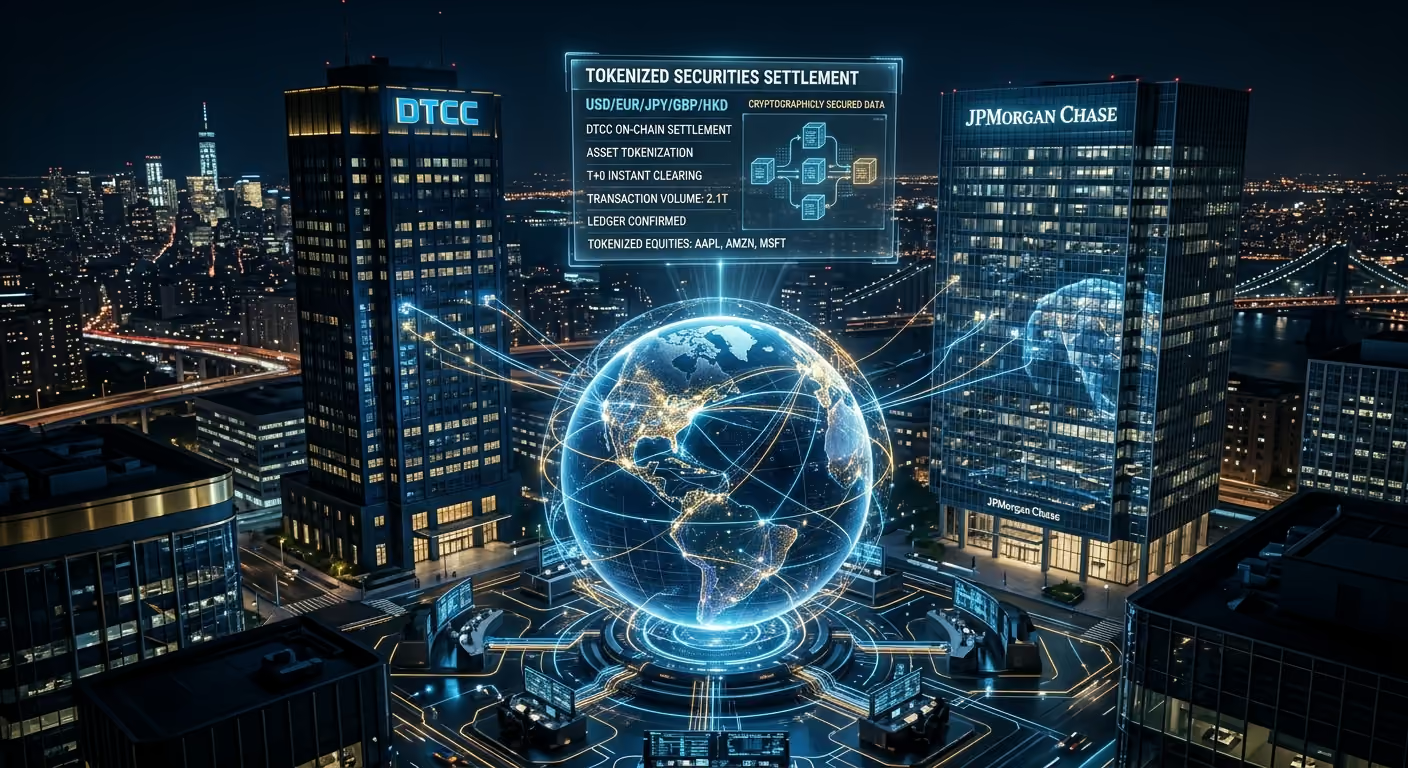
Corporate America Pushes Back on Stock Tokenization as SEC Adds RWA Risks to 2027 Priorities
Today, on October 28, 2026, the enterprise blockchain landscape reached a critical inflection point between market innovation and corporate governance. Building on last week's historic clearing engine deployments across global financial utilities, enterprise adoption is now forcing regulatory clarity, issuer consent frameworks, and advanced risk management protocols.
U.S. Corporate Giants Challenge Unauthorized Stock Tokenization
In a landmark confrontation over equity rights on-chain, more than 22 blue-chip U.S. corporations, including Wells Fargo, Intuit, Goldman Sachs, Microsoft, and Alphabet, have formally objected to overseas tokenized stock offerings. Platforms attempting to tokenize public equities without corporate consent have encountered unified pushback from corporate treasurers and transfer agents who warn of settlement ambiguity, proxy voting disruption, and regulatory arbitrage. In response to the friction, the U.S. SEC and Nasdaq issued formal FAQ guidance clarifying that secondary tokenized equity trading must strictly preserve underlying issuer rights, official share registry tracking, and compliance with federal securities laws.
SEC Formally Integrates Tokenization into Fiscal 2027 Priorities
Signaling that tokenized real-world assets (RWAs) have permanently entered systemic market infrastructure, the SEC Division of Examinations officially added tokenization risks and autonomous smart contract architectures to its Fiscal 2027 examination priorities. Federal examiners will specifically inspect registered entities on key custody security, valuation methodologies for tokenized private credit, operational resiliency, and compliance in multi-chain environments. Parallel to U.S. regulatory updates, Japanese regulators initiated plans to digitize and tokenize the uncleared 40% segment of Japan's Japanese Government Bond (JGB) repo market, aiming to reduce bilateral counterparty risk and automate liquidity management.
Enterprise Working Capital Tokenization Expands as AI Secures Contracts
Beyond capital markets, trade finance momentum accelerated as global working capital platform PrimeRevenue launched corporate payment draft tokenization on the Solana blockchain. The deployment converts short-term commercial receivables into programmable digital tokens, enabling corporate treasuries to unlock instant liquidity and secondary market distribution. To protect these multi-billion dollar trade flows, security researchers introduced automated generative AI diagnostic engines designed to audit smart contract codebases, identifying logical vulnerabilities before deployment. Concurrently, retirement services provider Empower submitted policy recommendations urging the IRS to adopt smart contracts to streamline multi-billion dollar retirement account rollovers.
The Bottom Line
- Issuer Governance is Mandatory: Corporate stock tokenization cannot bypass equity issuers; secondary tokenization models must integrate directly with corporate registries and transfer agent protocols.
- Regulatory Normalization: The SEC adding tokenization to its 2027 examination priorities demonstrates that digital assets are no longer a peripheral experiment but a core component of financial market oversight.
- Trade Finance Velocity: PrimeRevenue deploying tokenized corporate drafts on Solana highlights the growing appetite for high-throughput public blockchains in commercial supply chain settlement.
- Enterprise Blockchain Fun Fact: Japan's JGB repo market handles hundreds of billions of dollars daily. Tokenizing the uncleared 40% bilateral segment will liberate billions in locked-up capital while enabling continuous margin optimization across Asian financial hubs.
Stay Connected for Weekly Enterprise Blockchain Intelligence
Follow us to get the latest breaking Web3 infrastructure, smart contract analysis, and decentralized tech reports delivered weekly.
Aibots Sdn Bhd | [Beyond Future]