LLMs on $10 Silicon: Edge AI Shatters Hardware Barriers as Wi-Fi 6 Modules Drop to $2
Today is August 07, 2026, and the global hardware ecosystem has seen a massive surge of momentum in edge processing power, modular sensor designs, and low-power connectivity standards over the past seven days. In a week characterized by rapid shifts toward localized intelligence, the boundaries of what can be computed at the physical endpoint are being completely redrawn.
LLMs Conquer Ultra-Low-Cost Microcontrollers
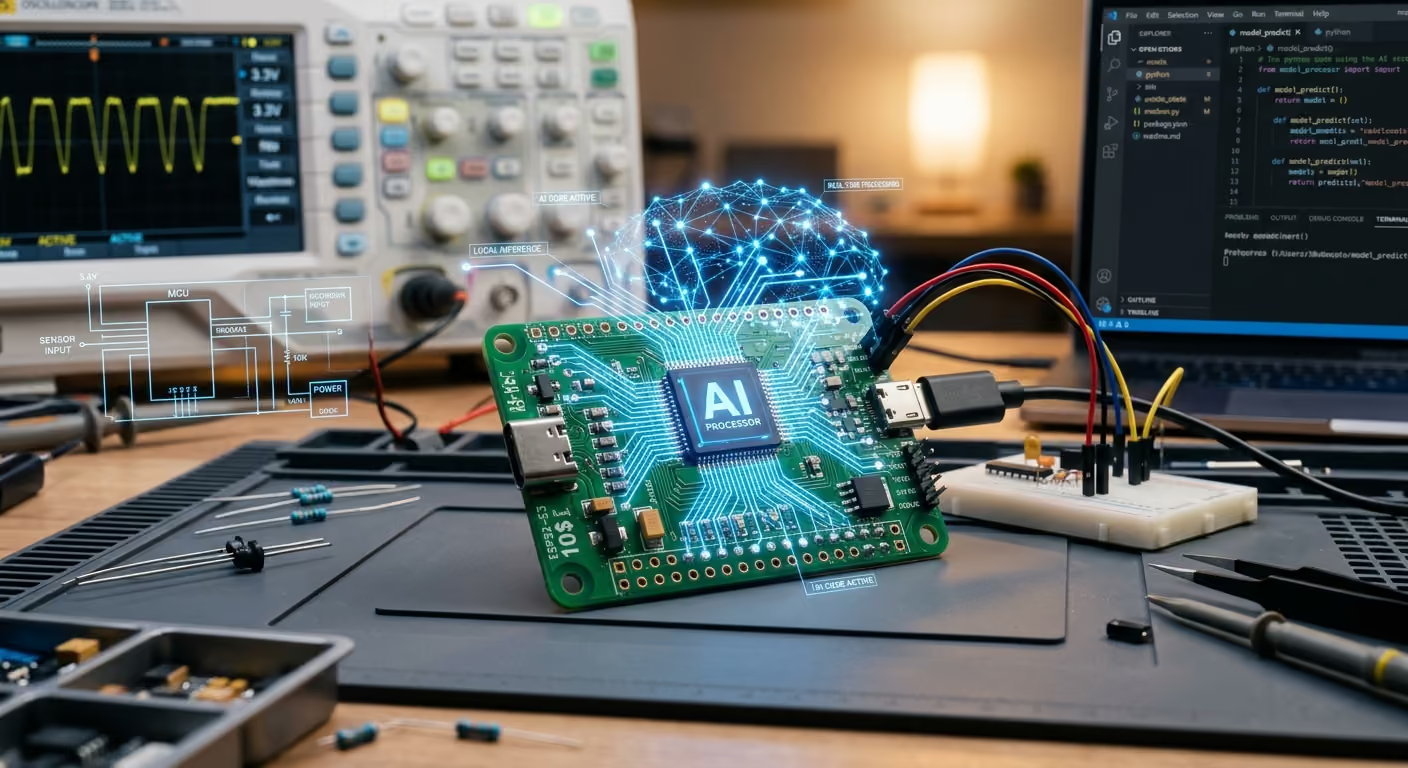
For years, industry analysts argued that large language models (LLMs) would remain forever bound to multi-gigawatt cloud datacenters or expensive, power-hungry edge GPUs. That paradigm was shattered this week when an independent developer successfully demonstrated an LLM running entirely localized on a simple ten-dollar microcontroller.
This breakthrough proves that highly optimized, compressed neural networks can perform basic natural language reasoning on ultra-low-power edge hardware. By eliminating the latency, bandwidth, and security concerns associated with sending voice and text data to the cloud, this development clears the way for smart appliances, localized industrial controls, and interactive field devices to operate autonomously in remote environments without any internet connection.
$2 Wi-Fi 6 Silicon Disrupts Smart Home and Industrial Markets
To support these increasingly intelligent endpoints, wireless silicon manufacturers are aggressively driving down the cost of high-bandwidth connectivity. Espressif Systems launched its new ESP32-C61-MINI-1 and ESP32-C61-MINI-1U modules, offering robust Wi-Fi 6 and Bluetooth 5 LE (BLE) capabilities for approximately two dollars. This low cost makes it financially viable for original equipment manufacturers (OEMs) to transition entire product lines to modern, high-throughput Wi-Fi 6 standards, which offer far superior network congestion management in dense device environments.
Simultaneously, NXP Semiconductors introduced its RW610FML low-power IoT Wi-Fi 6 and BLE microcontroller module. NXP's offering focuses heavily on secure-by-design architectures for commercial IoT systems, ensuring that even battery-powered industrial monitors can utilize secure, enterprise-grade Wi-Fi connections without draining their power reserves.
LoRa Alliance and eSIMs Solve the Deployment Bottleneck
As hardware units scale into the billions, provisioning and managing these networks remains a major operational headache. The LoRa Alliance has addressed this friction by introducing new specifications designed to simplify the zero-touch provisioning of LoRaWAN nodes. These standards allow massive industrial networks, such as utility grids or agricultural operations tracking livestock, to register thousands of sensor nodes to local gateways automatically without manual security key injection.
At the same time, cellular IoT is undergoing a major structural evolution. The cellular industry has begun actively building out infrastructure to support the new SGP.32 eSIM specification. This standard is designed specifically to scale cellular IoT deployments by allowing remote, over-the-air profile switching for millions of machines, cargo trackers, and connected vehicles worldwide, eliminating the logistical nightmare of physically swapping plastic SIM cards when changing network carriers.
Heavyweight Edge: Boeing 737 Certification and Autonomous Swarms
Edge computing is also reaching new heights in heavy machinery and aerospace. Teledyne announced that its GroundLink Edge Computing Platform has officially secured certification for Boeing 737 commercial aircraft. The system processes massive volumes of flight telemetry data directly on board, allowing airlines to perform predictive maintenance diagnostics immediately upon landing rather than waiting for slow, post-flight manual data transfers.
In the autonomous defense sector, Taiwan hosted a coordinated swarm exercise demonstrating an AI system autonomously managing three unmanned aerial vehicles (UAVs) in real time. Rather than relying on individual pilot controls, the AI algorithm dynamically distributed surveillance tasks and flight paths among the swarm, demonstrating the maturity of decentralized edge logic in tactical environments.
The Bottom Line
- Localized Edge AI is Real: Running LLMs on ten-dollar microcontrollers proves that high-level intelligence can now be deployed on cheap, offline physical endpoints.
- The $2 Wi-Fi 6 Era Has Begun: New modules from Espressif and NXP are making high-performance, secure wireless connectivity standard for even the most cost-sensitive IoT products.
- Zero-Touch Provisioning Takes Off: New specifications from the LoRa Alliance and the rollouts of SGP.32 eSIMs are removing the operational bottlenecks that previously blocked massive IoT fleets from scaling.
IoT Hardware Fun Fact: The shift toward running compressed models on microcontrollers means a modern smart home device can now process voice commands locally using only the energy it takes to light a single Christmas tree bulb, avoiding the massive carbon footprint of cloud-based voice servers.
Stay Connected for Weekly IoT & Edge Intelligence
Follow us to get the latest breaking Internet of Things, drone technology, sensor networks, and edge computing reports delivered weekly.
Aibots Sdn Bhd | [Beyond Future]