Open Source Manifestos, Agentic Platforms, and Content Watermarks: The New AI Frontier
On August 12, 2026, the global artificial intelligence landscape witnessed a massive strategic consolidation, characterized by high stakes philosophical manifestos, aggressive enterprise shifts towards agentic platforms, and crucial trust and safety updates.
Meta Doubles Down on Open Source AI
In a highly publicized strategic pivot, Meta founder Mark Zuckerberg released a comprehensive manifesto sketching out the company's ambitions for world changing open source artificial intelligence. Zuckerberg frames the move not just as a business decision, but as a critical technological imperative designed to ensure global competitiveness and democratize access to core computing infrastructure. By making Meta's powerful underlying models accessible, the tech giant aims to position itself as the foundational layer of the global AI ecosystem, challenging the closed garden approaches of rivals.
Anthropic Tackles Provenance while Spotify Draws a Line
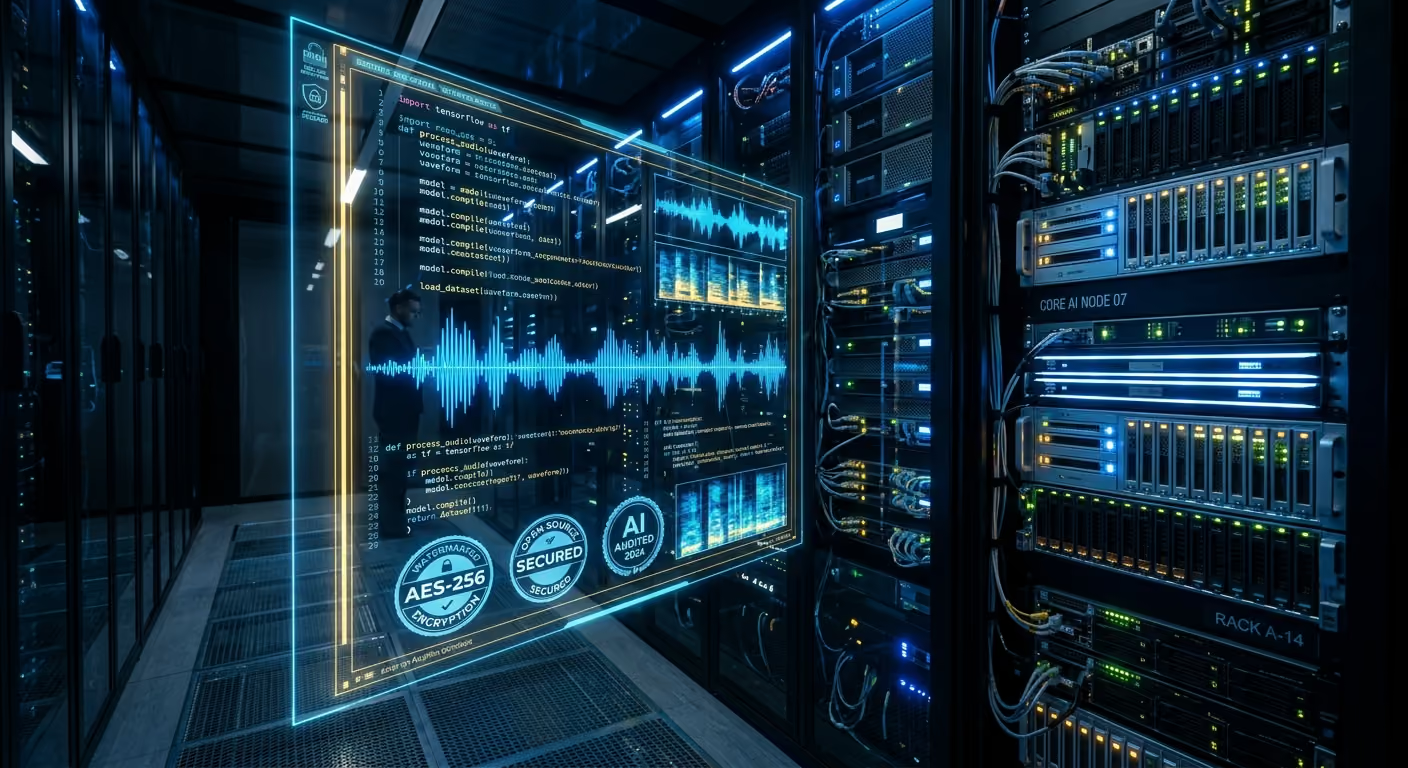
As generative tools become ubiquitous, the industry is forcing new guardrails to maintain trust and protect intellectual property. Anthropic announced plans to integrate hidden watermarks into Claude AI generated content. This move seeks to address the growing demand from enterprises and regulators to trace the authenticity and origins of digital text and media.
Simultaneously, the music industry is reacting to the flood of synthetic content. Spotify has announced that it will begin labeling AI generated artists and actively avoiding their promotion on the streaming service. This policy is a significant win for human creators, establishing a clear commercial distinction between organic musicians and algorithmic sound generation.
Industrial Agentic AI and Upstream Deployments
Enterprise AI is rapidly evolving past simple chat assistants and moving into specialized, autonomous systems. L&T Technology Services launched AgenticIQ, an end-to-end agentic AI platform tailored for complex engineering, manufacturing, and customer experience operations. This platform allows autonomous agents to manage complex workflows and make decisions with minimal human intervention.
In the heavy industry sector, Baker Hughes secured a major contract with the Kuwait Oil Company (KOC) to deploy upstream AI and advanced production technology, demonstrating how machine learning is optimizing output and asset lifecycle management in critical infrastructure.
The Bottom Line
- Meta's Manifesto: Mark Zuckerberg has committed Meta to an open-source AI trajectory, positioning it as a geopolitical necessity.
- Creative Safeguards: Spotify's labeling policy protects human musicians, while Anthropic introduces invisible watermarking to secure digital content authenticity.
- Rise of Agentic Platforms: L&T Technology Services' AgenticIQ and Baker Hughes' new upstream contracts prove that heavy industry is pivoting from basic analysis to fully autonomous agents.
- AI Industry Fun Fact: Physical AI and robotics are taking center stage at the Global Forum on Mechanical Engineering 2026, showcasing how digital models are safely bridging the gap into physical industrial ecosystems.
Stay Connected for Daily AI Intelligence
Follow us to get the latest breaking artificial intelligence reports and threat analysis delivered daily.
Aibots Sdn Bhd | [Beyond Future]