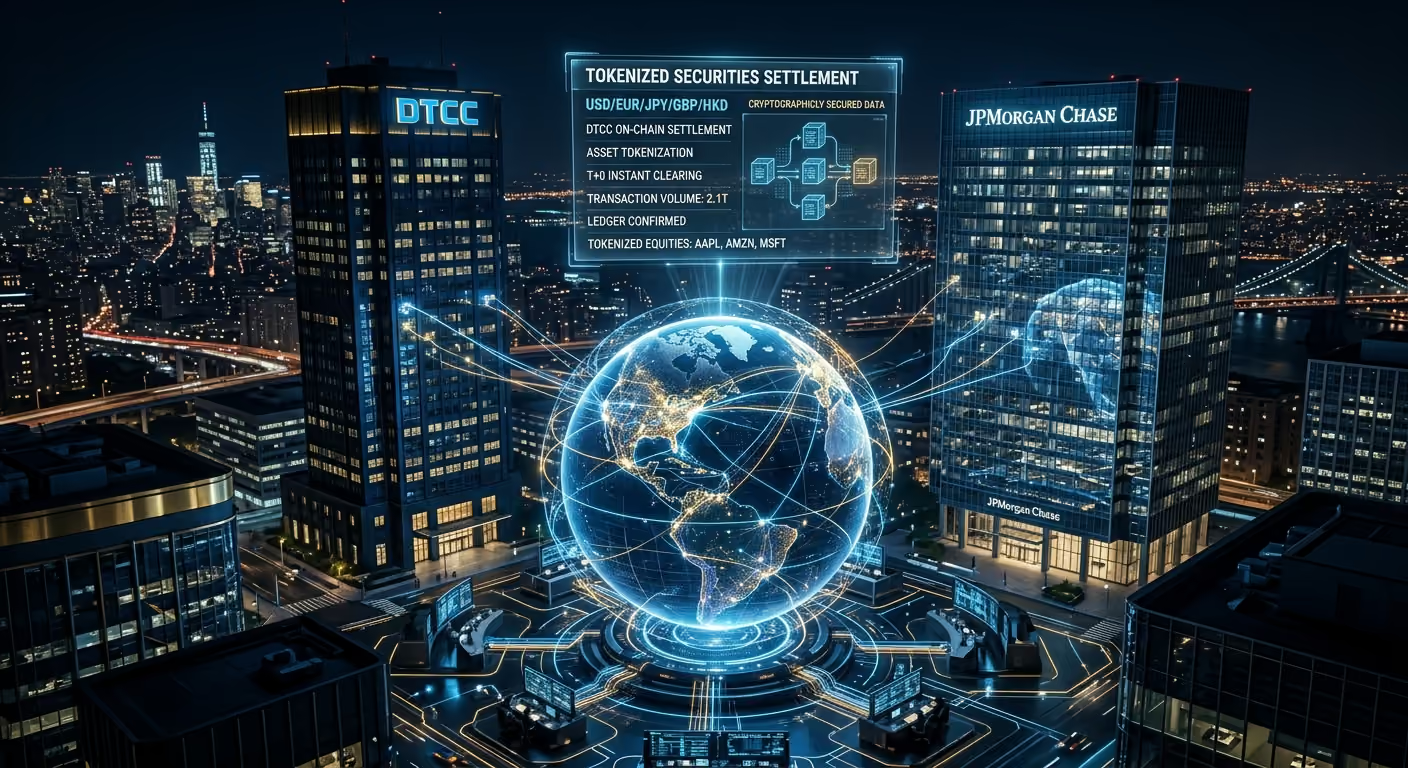
Wall Street and Sovereign Regulators Accelerate Capital Market Tokenization

Today, September 09, 2026, the structural overhaul of global capital markets is accelerating at an unprecedented pace, shifting from initial asset tokenization proof of concepts into deep systemic upgrades. This week's developments mark a watershed moment where the regulatory, institutional, and technical layers of financial infrastructure are simultaneously converging on distributed ledger technology.
Regulators Pivot: SEC Proposes Historic Transfer Agent Overhaul
Recognizing that traditional market structures are incompatible with always-on, round-the-clock digital settlement, the U.S. Securities and Exchange Commission (SEC) has proposed its first major overhaul of transfer agent rules in 40 years. Citing the rapid rise of tokenization and distributed ledger technology, the SEC's proposed updates aim to address the operational realities of tracking ownership on decentralized databases.
By modernizing the registry rules, the regulatory body is establishing a structured, compliant framework for public and private blockchains to natively record tokenized share ownership. This shift moves the industry past the era of manual reconciliation, clearing the path for institutional transfer agents to scale their digital asset divisions under clear compliance mandates.
Sovereign Rails: South Korea Mandates 2027 Blockchain Securities Rollout
In Asia, the push for state-backed tokenization has graduated to official national policy. South Korea's Financial Services Commission (FSC) and the Korea Securities Depository (KSD) have advanced a capital-markets tokenization roadmap designed to launch a fully operational, stablecoin-settled stock and bond tokenization market by early 2027.
To power this ecosystem, Hanwha Investment and Securities has begun constructing a dedicated tokenization platform on the Avalanche network. The initiative marks one of the most aggressive steps by a major global economy to shift national bond and equity registries onto shared ledgers, utilizing stablecoins for instant delivery-versus-payment (DvP) settlement cycles.
Financial Plumbing: Broadridge Launches DLX as DLT Repo Volume Hits $351 Billion Daily
While public discussions focus on future roadmaps, enterprise giant Broadridge is proving that heavy institutional volume is already live. Broadridge announced the launch of DLX, an always-on digital asset infrastructure platform specifically designed for tokenized markets.
Simultaneously, Broadridge has extended its distributed ledger technology (DLT) repo solution from the United States to include G7 securities. With over 351 billion dollars a day already being tokenized on Broadridge's systems, the expansion of its DLT repo rails allows global financial institutions to manage liquidity and collateral with real-time settlement, eliminating hours of back-office friction and significantly lowering counterparty risk.
Smart Contract Resiliency: AERSeal Combats Single-Key Vulnerabilities
As transaction volumes scale, security parameters are evolving from traditional multisig setups to native smart contract controls. Enterprise security provider AEREDIUM has launched AERSeal, an innovative architectural framework designed to eliminate single private key vulnerabilities in smart contracts.
Instead of relying on a single administrative key (which represents a critical point of failure for institutional treasuries) AERSeal decentralizes protocol administrative permissions. This ensures that no single compromised key can alter smart contract parameters, drain custody vaults, or halt trading operations, resolving one of the largest security bottlenecks preventing risk-averse institutions from deploying capital on-chain.
Cross-Chain and Institutional Issuance: Chainlink, Stellar, and Nasdaq Share Tokenization
Institutional adoption is further supported by major cross-border and custody milestones:
- Standard Chartered Endorsement: Standard Chartered released an analysis identifying Chainlink as the primary infrastructure rails capable of driving a projected 4 trillion dollar tokenization boom, pointing to its cross-chain interoperability protocol as essential for uniting fragmented bank ledgers.
- DTCC Connects to Stellar: The Depository Trust and Clearing Corporation (DTCC) is connecting its tokenization services to Stellar for tokenized assets, targeting a full launch by the second quarter of 2027 to lower minimum investment thresholds to as little as 5,000 dollars.
- Nasdaq Share Tokenization: Technology issuer Mint completed a sponsored tokenization initiative of its Nasdaq-listed Class A ordinary shares across both Ethereum and Solana, driving a 43 percent stock rally and demonstrating the viability of dual-chain public security issuance.
The Bottom Line
- Infrastructure Scaled: Broadridge's DLX and G7 repo expansion show that enterprise DLT is no longer an experiment, it is actively clearing hundreds of billions of dollars daily.
- Sovereign Commitment: South Korea's 2027 target and SEC's transfer agent updates confirm that governments are rewriting the rulebook to support always-on ledger transactions.
- Interoperable Ecosystems: The integration of Stellar, Chainlink, and public networks like Avalanche, Ethereum, and Solana shows that the future of finance is multi-chain, secure, and regulatory-compliant.
Enterprise Blockchain Fun Fact: Broadridge's DLT repo system currently tokenizes over 351 billion dollars daily, proving that enterprise blockchain is already handling mission-critical transaction volume that dwarfs public retail crypto markets.
Stay Connected for Weekly Enterprise Blockchain Intelligence
Follow us to get the latest breaking Web3 infrastructure, smart contract analysis, and decentralized tech reports delivered weekly.
Aibots Sdn Bhd | [Beyond Future]