Amazon Unleashes $20 Billion AI Spending Surge Amid Fierce Global Regulatory Showdowns

Amazon Leads the Multi-Billion Dollar Infrastructure Charge
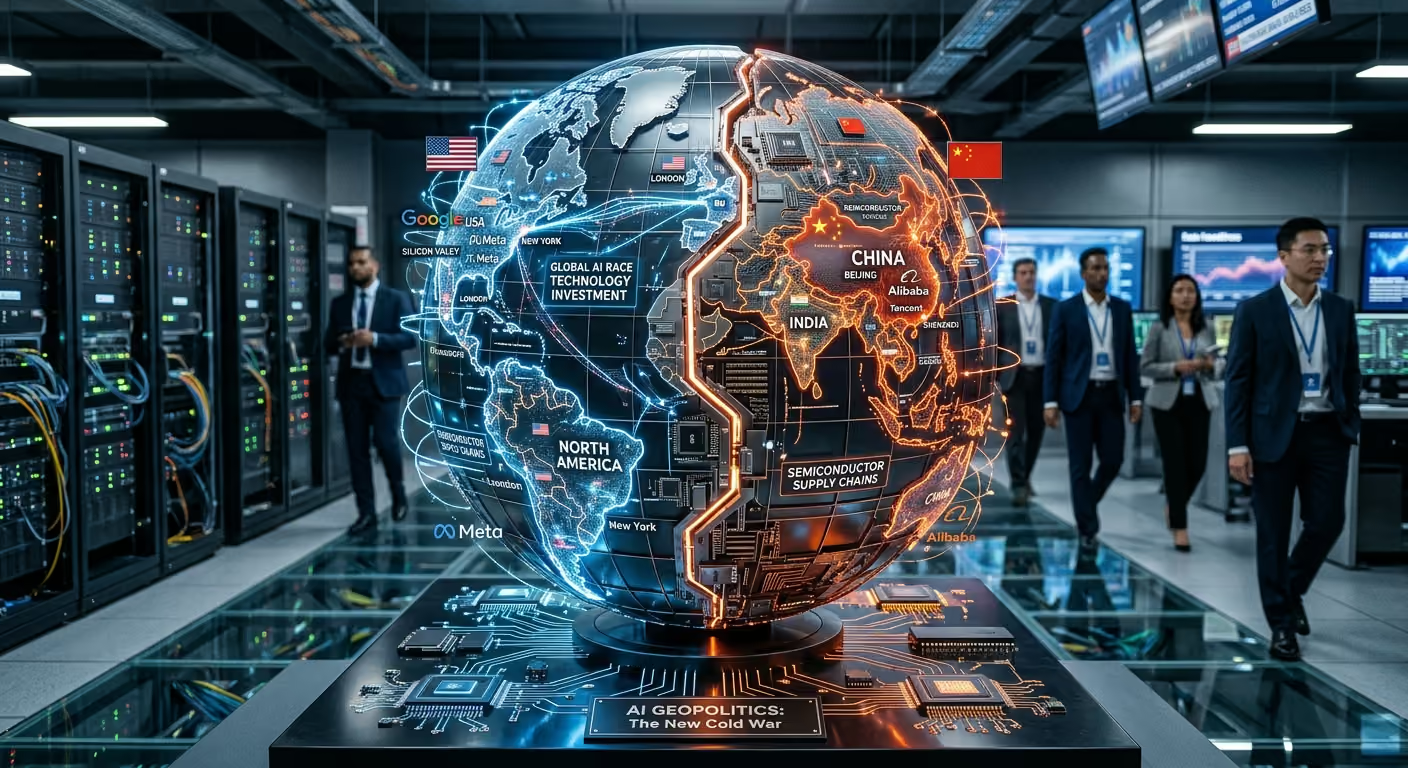
Today is July 31, 2026, and the global artificial intelligence landscape is witnessing an unprecedented clash between colossal infrastructure investments and mounting regulatory and judicial resistance. As tech giants deploy vast fortunes to secure algorithmic supremacy, the boundaries of legal oversight, resource constraints, and human trust are being thoroughly redrawn.
Following a stellar second quarter earnings report, Amazon has announced a massive $20 billion boost in capital spending dedicated to artificial intelligence and foundational technologies. This cash injection will accelerate the expansion of its global cloud networks, proprietary silicon production, and large-scale model training infrastructure. The escalation underscores a growing consensus among hyper-scalers: holding onto market share requires a continuous, capital-intensive expansion of computational capacity.
At the same time, hardware paradigms are shifting. Researchers have unveiled a breakthrough brain-inspired AI model capable of complex planning and real-time adaptation without relying on massive, centralized data centers. This neurological approach could eventually offer a highly efficient alternative to the energy-hungry cloud clusters currently dominating the market.
Judicial Doubts and the Battle Over Bans
The rush to build AI systems is colliding head-on with government scrutiny. In a notable legal development, a federal judge has voiced significant skepticism regarding whether the United States government has sufficiently justified its ban on Anthropic AI. The skepticism highlights the growing friction between national security agencies and the commercial AI sector, where sweeping restrictions are increasingly met with demands for transparent, evidence-based policy.
Concurrently, social and content restrictions are facing intense legal pushback. Elon Musk's company has filed a lawsuit against a state government over the first US ban targeting AI "nudification" technology. The legal challenge sets up a complex constitutional battle, pitting deepfake regulations and privacy protections against corporate arguments for free expression and technology platform immunity.
Enterprise Integration: Trust Over Hype
On the enterprise adoption front, companies are learning that system capability is only half the battle. Industry analyses in sectors like construction and logistics emphasize that user trust beats raw algorithmic capability every single time. Practical strategy is rapidly replacing technology noise as executives focus on measurable business outcomes.
To that end, specialized applications are gaining ground. Stellarus has officially launched a dedicated AI copilot specifically designed for health plan customer service representatives, helping them navigate complex healthcare benefits in real time. This micro-targeted approach is mirrored in public policy: new education laws in Tennessee have officially changed how public schools approach, integrate, and regulate AI technology within classrooms, ensuring the next generation is prepared for an automated workforce.
The Bottom Line
TL;DR Summary
- Capital Surge: Amazon is injecting an extra $20 billion into AI infrastructure following a highly successful Q2.
- Regulatory Friction: A federal judge has cast doubt on the US ban of Anthropic AI, while Elon Musk's platform sues over a state deepfake ban.
- Strategic Shift: Enterprise leaders are prioritizing localized, brain-inspired architectures and human trust over massive, ungrounded cloud deployments.
---
Stay Connected for Daily AI Intelligence
Follow us to get the latest breaking artificial intelligence reports and threat analysis delivered daily.
Aibots Sdn Bhd | [Beyond Future]