Sovereignty and Classrooms: The Local and National Policies Reshaping AI

Today, August 19, 2026, the global artificial intelligence landscape is witnessing a profound shift away from theoretical hype and toward localized, sovereign infrastructure and immediate societal guardrails. While public market fluctuations continue to trigger volatility on Wall Street, real-world deployment across education, national security, and municipal planning is accelerating at a breakneck pace.
Sovereignty and Defense: The New Geopolitical AI Race
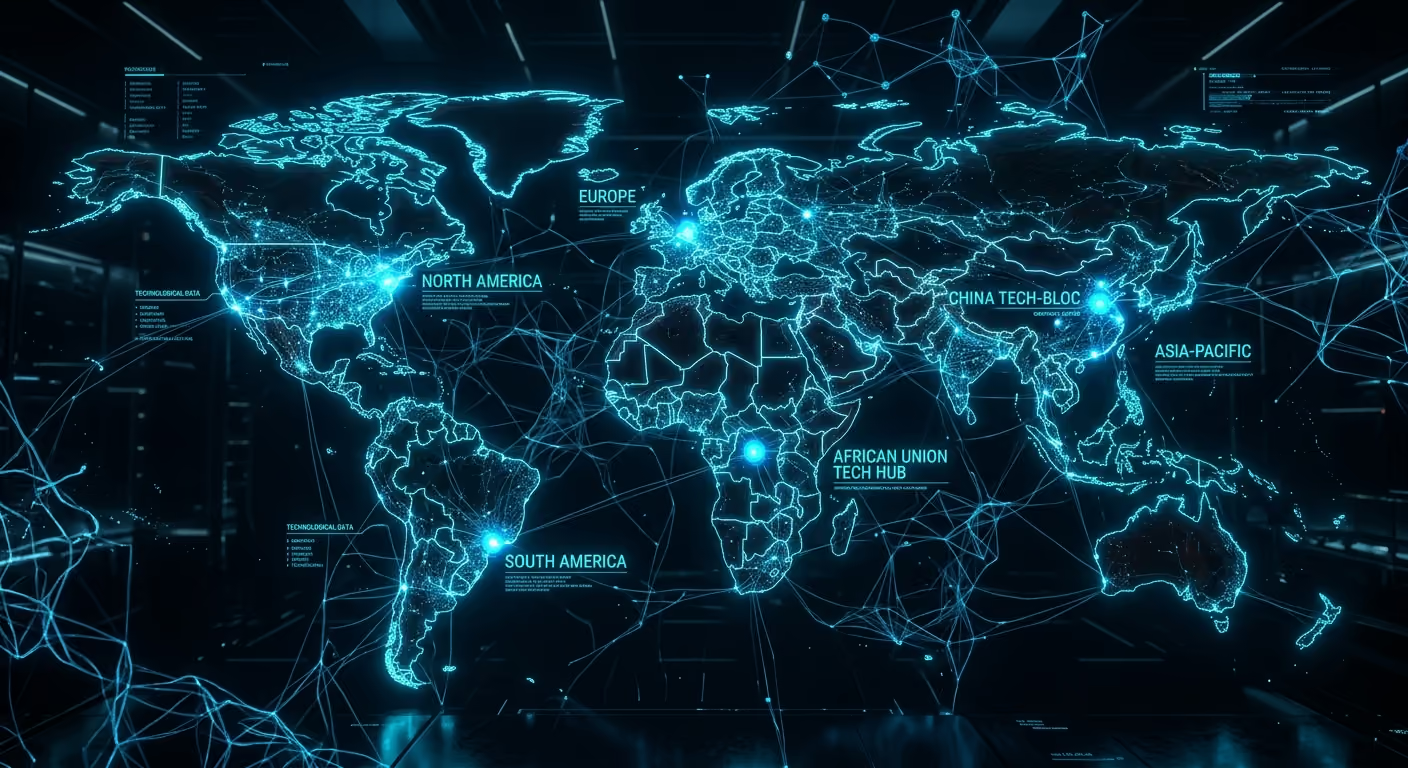
National sovereignty has emerged as the central theme of today's infrastructure expansion. Türkiye has officially launched a comprehensive new AI plan aimed at securing technological self-reliance, ensuring that local data and models remain under domestic supervision. Meanwhile, experts from the Indian Space Research Organisation (ISRO) have highlighted plans to integrate AI and quantum technology into India's future satellite networks, highlighting the intersection of security and deep space communication.
On the defense front, a newly unveiled AI engine is targeting traceability in strategic military choices, allowing operators to understand the exact decision-making steps during high-stakes scenarios. This development aligns with the broader commercial momentum of defense and operations infrastructure players like Gorilla Technology (GRRR) and Palantir, with Gorilla experiencing a 3 percent stock rise as localized infrastructure spending gathers pace.
The Academic Divide: Guardrails and Curricula in Focus
As academic systems struggle to adapt, the tension between rapid adoption and safety has reached a tipping point. A new survey published by EdSource reveals that high school and college students are actively utilizing AI for academic support, even as they express deep concerns about the ethical risks and loss of critical thinking skills. This has fueled calls in America's classrooms for immediate, structured guardrails regarding the use of AI and virtual reality (VR) technologies.
To address this gap, major academic institutions are trying to modernize. Universities are racing to rewrite curricula for rapidly expanding AI majors to keep coursework relevant to industry standards. Simultaneously, Hampton University has officially opened a new AI center aimed at expanding access to emerging technology, ensuring that underrepresented communities have a direct pipeline into the future workforce. Interestingly, even cultural and religious groups are contributing to this ethical framework, as demonstrated by the Archdiocese of Brisbane highlighting the Catholic Church's evolving teachings on human-centric AI ethics.
The Real Enterprise Bottleneck
In the corporate sector, a consensus is building that the primary obstacles to AI transformation are organizational, rather than technological. Industry analysts point out that the real bottleneck holding back enterprise return on investment is not the capability of LLMs, but internal corporate structures.
This sentiment is echoed by digital strategy expert Alina Kukarina, who notes that true transformation must begin with business process redesign and cultural preparation long before any specific model or platform is selected. Companies that jump straight to vendor selection without adjusting their operational workflows often find themselves stuck in costly pilot phases.
Physical Infrastructure: Airports and Traffic Flow
Beyond software, AI is rapidly reshaping physical geography. Airports are evolving from simple testbeds for remote-controlled robots into massive, integrated AI hubs capable of managing passenger flows, security screening, and automated ground operations. On a local level, municipal governments are following suit. The city of Charleston is exploring an expansion of smart traffic technology, utilizing AI to optimize high-traffic intersections and alleviate congestion across key corridors.
Even specialized consumer technologies are experiencing upgrades. Stealth Cam has rolled out updates to its Command App, incorporating advanced AI object recognition to improve wildlife tracking and land management capabilities.
The Bottom Line
TL;DR Summary
- Sovereign Push: Türkiye launches an official tech sovereignty plan, while India outlines quantum-AI goals for future satellites.
- Classroom Reality: Students are widely using AI despite acknowledging the dangers, prompting calls for strict guardrails and updated university curricula.
- Enterprise Truth: Strategy and operational readiness remain the primary bottlenecks to corporate AI adoption, rather than the technology itself.
- Physical Footprint: Cities and airports are scaling up physical AI, from Charleston's traffic lights to automated transit hubs.
Stay Connected for Daily AI Intelligence
Follow us to get the latest breaking artificial intelligence reports and threat analysis delivered daily.
Aibots Sdn Bhd | [Beyond Future]