Hollywood's $110 Billion AI Gamble and Medical Breakthroughs Spark Nationwide Debate
Today, October 09, 2026, the artificial intelligence sector reached a historic flashpoint marked by massive commercial consolidation, groundbreaking clinical validations, and rising public anxiety.
Hollywood Finalizes Landmark $110 Billion AI Deal
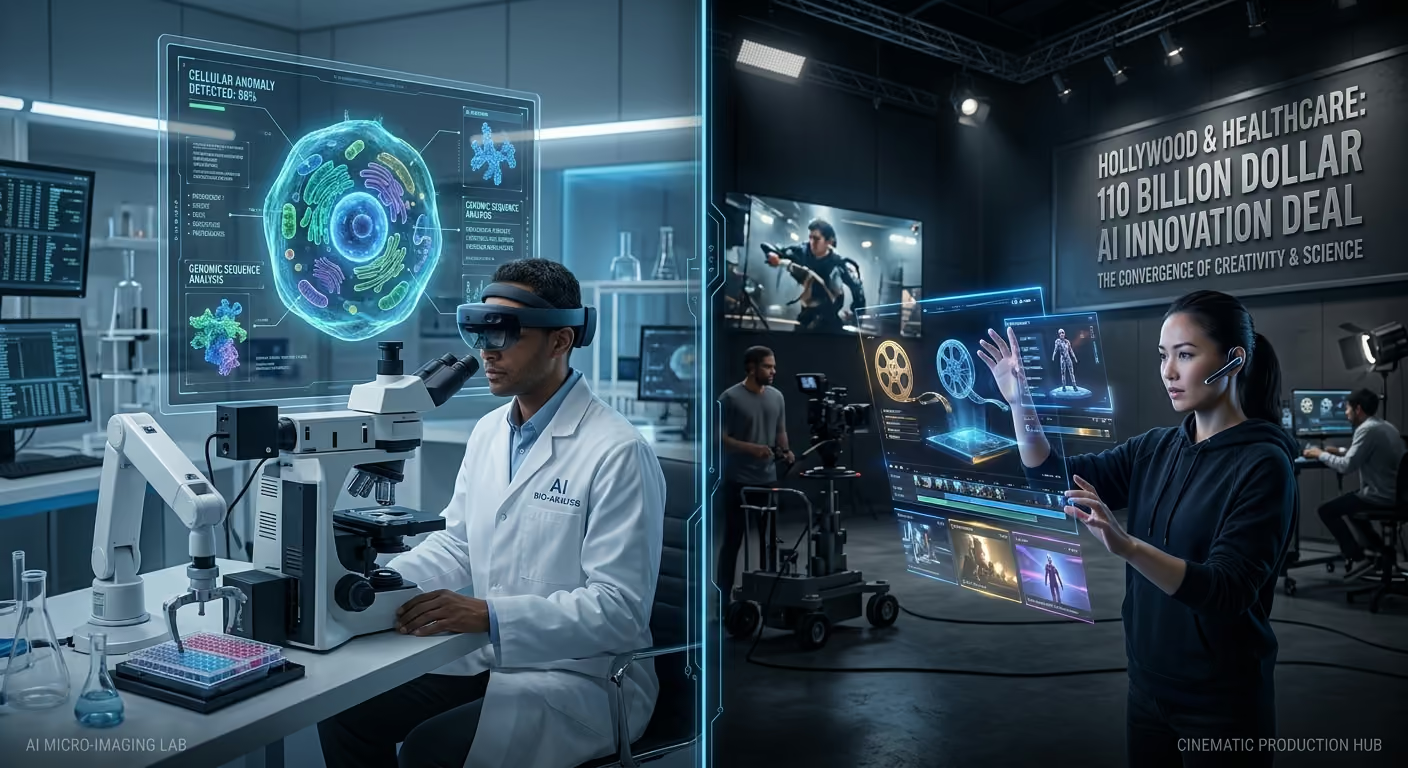
The entertainment industry has taken its most decisive step yet into the digital future. Major Hollywood giants have finalized a monumental 110 billion dollar deal designed to systematically integrate AI throughout production, special effects, and distribution channels. This unprecedented transaction is poised to completely reshape how content is created, signaling a permanent shift in the media landscape.
Healthcare AI Advances from Labs to Urgent Care Clinics
In the medical arena, AI is transitioning rapidly from experimental technology to frontline support. A newly published clinical trial indicates that AI chatbots could play a crucial role in aiding urgent care, helping triage patients and assist busy clinical workflows. This clinical milestone is bolstered by other technological leaps:
- Cell Screening Innovation: The new SPARCS technology successfully combines AI with high-resolution microscopy to screen and analyze cells, opening new doors for drug discovery.
- Major Collaborations: The University of Delaware showcased its cutting-edge health technology, which underpins a massive 21.5 million dollar AI partnership.
- The Data Question: As clinical applications scale, public anxiety is rising regarding medical records. With medical data becoming an AI gold mine, intense debates have emerged over who actually owns this highly sensitive information.
Political Pledges and Enterprise Bottlenecks
The political and corporate fronts are moving at an equally turbulent pace. Donald Trump secured a 2.4 billion dollar AI pledge while honoring tech leaders Elon Musk and Nvidia CEO Jensen Huang. However, critics point out a growing paradox: the administration is calling on AI to drastically accelerate scientific progress while simultaneously pursuing policies that defund core scientific research.
For enterprises looking to adopt these technologies, the hurdle is rarely the AI models themselves. A new report highlights that aging legacy systems are now the primary obstacle preventing businesses from successfully deploying modern AI tools.
Public Backlash: Is Technology Moving Too Fast?
Despite these multi-billion dollar advancements, the general public remains highly skeptical. A new AP-NORC poll reveals that a clear majority of adults believe artificial intelligence is developing far too rapidly. This anxiety is mirrored on the ground: in the San Francisco Bay Area, residents are actively wrestling with AI through events ranging from killer-robot protests to introductory tech talks for seniors. Even in academia, Emory University humanities and social science faculty are actively debating whether to enforce tech-free classrooms to preserve traditional learning environments.
The Bottom Line
- Enterprise Reality Check: Aging infrastructure remains the ultimate bottleneck for corporate AI adoption, rendering even the most advanced models useless without backend upgrades.
- The $110B Entertainment Bet: Hollywood's massive consolidation proves that the industry views generative AI not as a temporary fad, but as the foundational engine of future media.
- Public vs. Private Disconnect: While politicians and tech executives celebrate multi-billion dollar pledges, the average citizen is growing increasingly uneasy with the velocity of AI deployment.
Stay Connected for Daily AI Intelligence
Follow us to get the latest breaking artificial intelligence reports and threat analysis delivered daily.
Aibots Sdn Bhd | [Beyond Future]