Microchip Acquires Hailo and Hyundai Bets Big on Physical AI in Silicon Valley
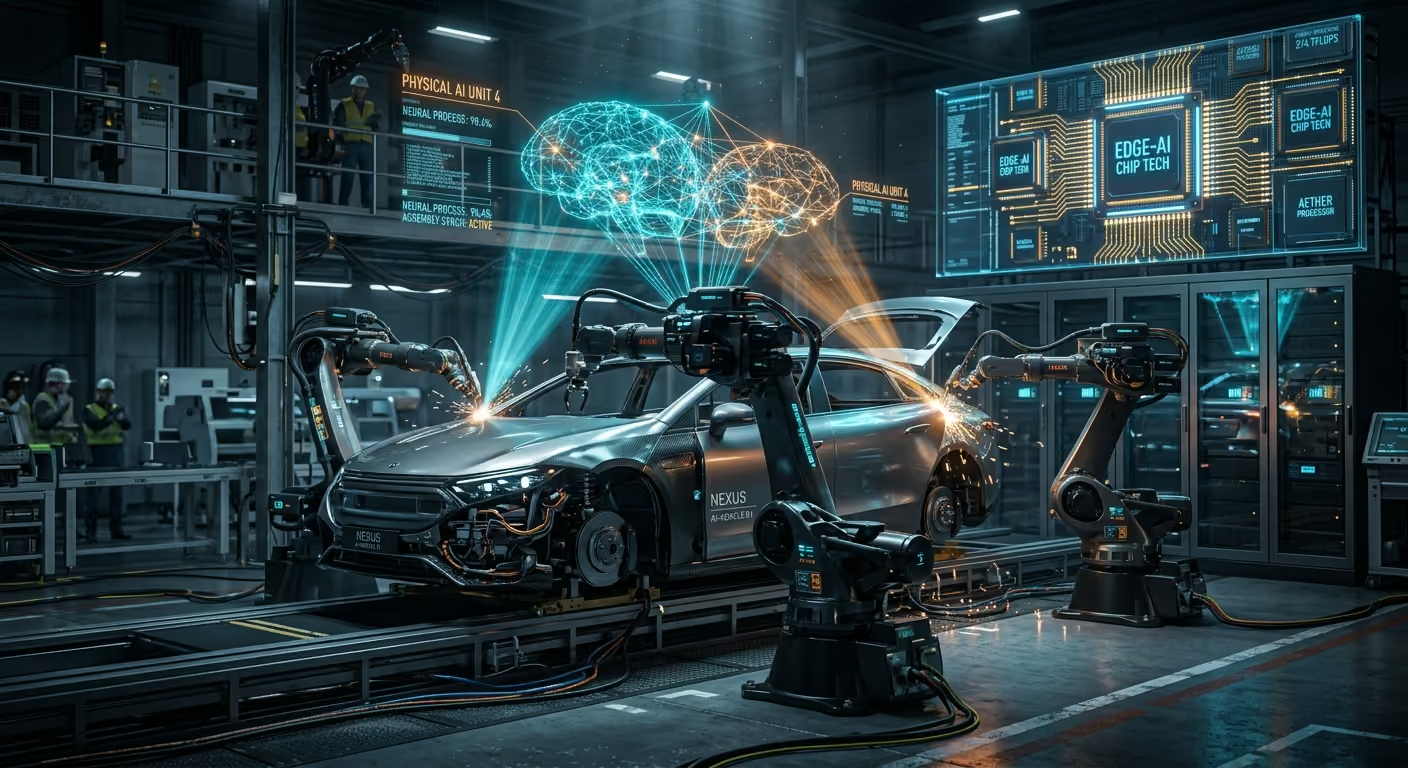
Today is July 26, 2026, and the global artificial intelligence sector is undergoing a rapid transition marked by hardware consolidation, ambitious physical robotics initiatives, and massive public sector audits.
Microchip Snaps Up Hailo in Major Edge-AI Consolidation
In a significant consolidation event for the artificial intelligence hardware sector, Microchip has acquired the Israeli edge-AI chip startup Hailo. Once celebrated as a semiconductor unicorn with a valuation exceeding 1 billion dollars, Hailo experienced a dramatic fall from its peak before the acquisition went through. This acquisition highlights the intense market pressures facing independent chip startups as dominant semiconductor giants absorb specialized edge-AI technology.
The hardware battle is heating up across all tiers, with investors closely watching the performance of major players like Micron Technology and SanDisk. As memory demands for advanced generative AI models continue to rocket upward, efficient edge processing and high-performance memory chips are becoming the primary battleground for tech supremacy.
Hyundai Targets "Physical AI" Leadership in Silicon Valley
While hardware consolidation reshapes the chip market, Hyundai Motor Group is shifting its focus to the tangible world. Speaking in Silicon Valley, Hyundai Motor Group Executive Chair Chung Eui-sun announced an ambitious vision to transform the automotive giant into a global leader in physical AI.
This strategy involves deeply integrating machine learning and neural networks into physical machinery, ranging from autonomous vehicles to advanced robotics. Rather than focusing solely on digital software interfaces, Hyundai aims to bridge the gap between artificial neural networks and kinetic real-world applications.
AI Audits Flag 640,000 Anomalies in Bengaluru
On the public infrastructure front, municipal authorities in Bengaluru have successfully utilized artificial intelligence to perform a massive sweep of administrative data. A special intensive revision utilizing AI algorithms detected over 6.41 lakh (641,000) anomalies in the city's voter and registration databases.
This deployment showcases the growing reliance of municipal governments on deep data analysis to clean up massive public datasets, highlighting how AI is transforming civic administration.
Mitigating Professional Hesitancy and Worker Risks
As AI tools spread through public and private sectors, human adaptation remains a core bottleneck. In the healthcare sector, a new peer-led instructional design published in Cureus has shown success in addressing clinician-educator hesitancy toward artificial intelligence. By using peer-guided training programs, medical educators are learning to integrate AI into clinical teaching without compromising patient safety.
However, the macroeconomic risks of this rapid transition are sparking intense debate. In Augusta, Georgia, a public hearing on AI weighed the substantial economic benefits of local technological adoption against the risks to worker stability. This localized debate reflects broader warnings from economists, including a recent South Korean report drawing comparisons between current service-sector job displacement and the rise of idle citizens in ancient Rome.
The Bottom Line
- Market Consolidation: Microchip's acquisition of Hailo shows that independent edge-AI chipmakers are finding it increasingly difficult to survive solo without backing from massive hardware giants.
- Kinetic AI Expansion: Hyundai's "physical AI" push proves that the next frontier of artificial intelligence is physical, focusing on real-world movement rather than just chat interfaces.
- Civic Cleanups: Bengaluru's discovery of 641,000 anomalies proves that AI is now a critical utility for basic civic administration and database integrity at a massive scale.
Stay Connected for Daily AI Intelligence
Follow us to get the latest breaking artificial intelligence reports and threat analysis delivered daily.
Aibots Sdn Bhd | [Beyond Future]