Satellite IoT Projected to Reach 197 Million Connections as GKN Aerospace Unveils Sweden-Backed Military UAV Demonstrator
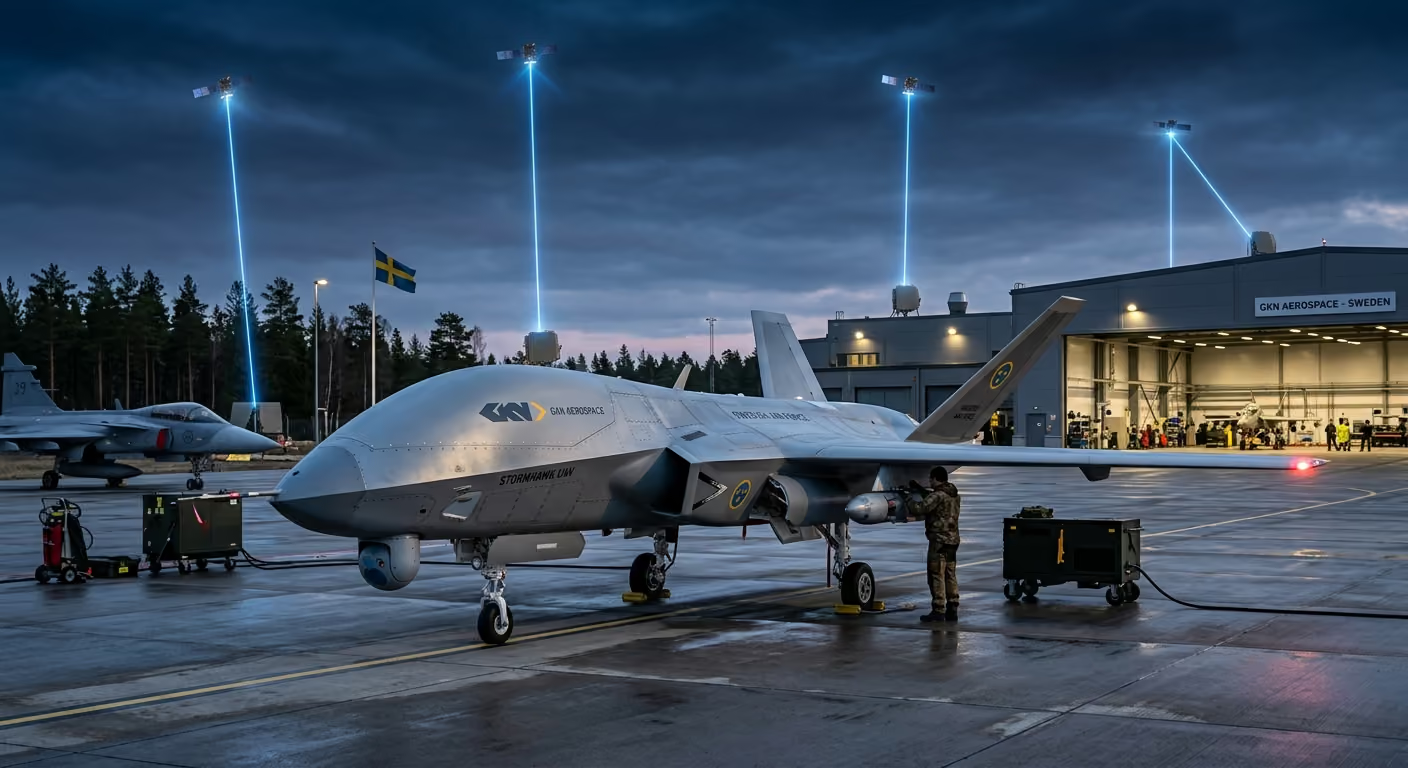
Today is August 28, 2026, and the global connected hardware ecosystem is surging forward with massive strides in orbital IoT networks, rapid military aviation prototyping, and smart industrial automation.
Following weeks of terrestrial network optimizations, this week's breakthrough developments show that edge processing and telemetry are rapidly ascending into low Earth orbit while commercial and military autonomous platforms secure highly specialized local silicon.
The Orbital IoT Revolution: 197.7 Million Connections by 2035
Terrestrial cellular networks are no longer the absolute boundary for IoT. According to a new market forecast by analyst firm Omdia, satellite IoT connections are projected to reach 197.7 million by 2035. This massive growth is driven by the declining cost of satellite launches, the deployment of dense low Earth orbit (LEO) constellations, and the demand for uninterrupted asset tracking in maritime, logistics, and agriculture.
But simple connectivity is only half the story. Space-edge computing is actively merging with these satellite networks. Ground station operator KSAT and aerospace computing specialist Unibap have announced a new partnership to bring edge computing capabilities directly to the Hyper satellite constellation. Rather than beam raw, high-bandwidth sensor data back to Earth, these satellites will run localized inference algorithms in orbit, transmitting only the vital processed data to users on the ground.
In parallel, L2 Aviation and Gotonomi have extended UAV connectivity far beyond cellular reach. By integrating hybrid satellite-terrestrial communication terminals onto unmanned aerial systems, the partnership ensures that autonomous drones can maintain secure, redundant control links even when navigating the most remote regions on Earth.
Military UAV Acceleration: GKN Aerospace Unveils Sweden-Backed Technology Demonstrator
In the defense sector, rapid hardware prototyping has reached a major milestone. GKN Aerospace has officially unveiled its new military UAV technology demonstrator, designed and built within the very first year of the Sweden-backed program. This fast-track development showcases a shift toward agile manufacturing methodologies in defense aviation, allowing militaries to test and deploy aerodynamic hulls, sensor bays, and propulsion systems at a fraction of traditional timelines.
To power the increasingly complex control systems of these next-generation unmanned aircraft, GCT Semiconductor has formed a strategic partnership aimed at developing highly integrated control and communications chips. These specialized microcontrollers will combine high-frequency flight telemetry processing with secure, jam-resistant communications on a single piece of silicon, minimizing weight and power draw inside the drone's fuselage.
AgTech IoT Set to Value at $12.61 Billion as Precision Robotics Scale
On the commercial front, agricultural automation is transitioning from a niche upgrade to a primary operational standard. A newly published market study reveals that the global Agriculture IoT market is on track to hit 12.61 billion dollars by 2030, driven by the relentless integration of AI-powered tractors, automated soil sensors, and crop-monitoring drones.
Demonstrating this trend, ZenaTech has secured the prestigious 2026 AgTech Breakthrough Award for Drone Technology of the Year. ZenaTech's specialized aerial platforms leverage precise multi-spectral cameras and automated payload delivery to assess crop health and apply micro-treatments autonomously.
Furthering this automation, researchers have introduced new smart irrigation models leveraging edge computing and machine learning. By utilizing localized soil moisture sensors, weather telemetry, and embedded neural networks directly on field-level microcontrollers, these intelligent systems adjust water management schedules dynamically, reducing water consumption while maximizing crop yields.
The Bottom Line
- Space is the New Edge: The projected rise to 197.7 million satellite IoT connections demonstrates that heavy industrial operations are shifting toward orbital backhauls to eliminate terrestrial dead zones.
- Defense Moves at Startup Speed: GKN Aerospace's Sweden-backed UAV program demonstrates that advanced military hardware can go from concept to physical demonstrator in under twelve months when backed by modern digital twin technology.
- Silicon is Specializing: Partnerships like GCT Semiconductor's UAV chip initiative reveal that standard off-the-shelf microcontrollers are giving way to application-specific integrated circuits designed specifically for autonomous flight control.
IoT Hardware Fun Fact: Space-edge computing modules, like those developed by Unibap and KSAT, must be specifically radiation-hardened or rely on advanced software-level redundant fault tolerance to survive the harsh radiation of low Earth orbit while running real-time machine learning inference.
Stay Connected for Weekly IoT & Edge Intelligence
Follow us to get the latest breaking Internet of Things, drone technology, sensor networks, and edge computing reports delivered weekly.
Aibots Sdn Bhd | [Beyond Future]