US Demands Allies Choose Sides in AI Cold War as Alibaba Crosses 3 Billion Downloads

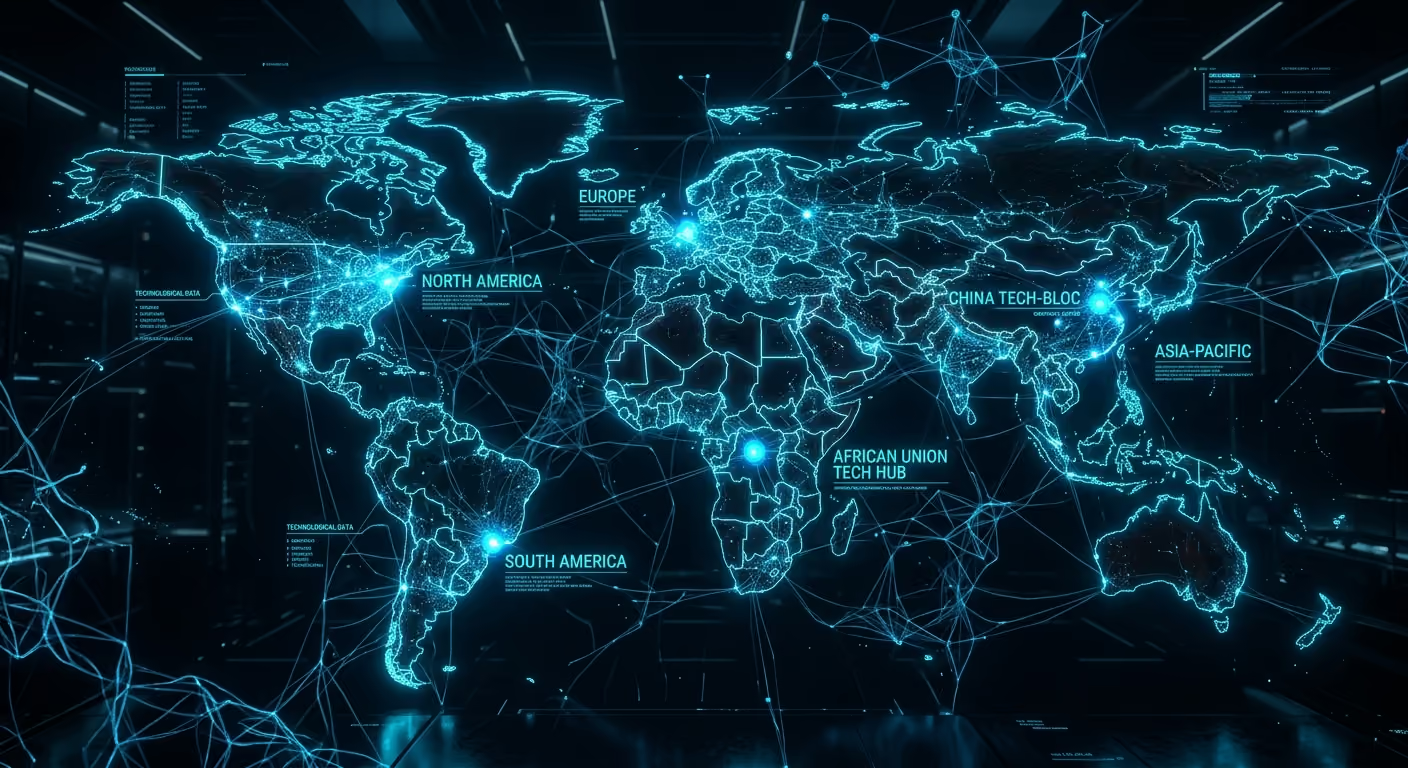
Today, on August 16, 2026, the global artificial intelligence landscape is witnessing a dramatic geopolitical fracturing as the United States prepares a formal diplomatic campaign to force international allies to align against China's accelerating AI ecosystem. This high-stakes move coincides with massive shifts in open-source AI adoption, academic integrity, and physical data acquisition, signaling a new era of fragmented technology blocks.
Geopolitical Lines Drawn as Alibaba Dominates Downloads
The United States is preparing to urge its international partners to choose sides in the rapidly intensifying AI rivalry with China, setting the stage for a fragmented technological world order. This diplomatic push arrives just as Chinese tech giant Alibaba announced that its open-source AI models have crossed a historic milestone of 3 billion downloads, surpassing developers like Meta and Google.
While western analysts at institutions like the Mises Institute debate whether models like DeepSeek and Kimi 3 prove Chinese technological supremacy, the raw distribution numbers tell a story of massive global adoption. As Washington demands that its allies block or restrict Chinese AI architectures, the ubiquity of these open-source models makes a clean decoupling extraordinarily difficult for global enterprises.
Academic Institutions Abandon the Detection Fight
In a major shift for higher education, Nanyang Technological University (NTU) has announced plans to completely ditch AI plagiarism detectors. The university stated that current detection technologies are simply too unreliable to definitively prove student cheating.
This decision highlights a growing consensus among global educators that the cat-and-mouse game of AI text detection is over. Rather than relying on flawed algorithmic cops, universities are moving toward redesigned assessments that assume generative AI is an accessible, everyday tool for students, moving beyond simple chatbots and prompts.
The Scramble for Clean Data: AI Firms Raid Secondhand Bookshops
In one of the most unusual developments of the year, secondhand booksellers across the United Kingdom and Ireland are reporting bizarre bulk orders of physical books. Shop owners suspect that prominent AI development firms are behind these mysterious transactions.
With digital internet archives increasingly exhausted, scraped, or locked behind paywalls, AI companies are turning to physical, out-of-print literature to train the next generation of large language models. These offline texts represent an untapped goldmine of high-quality, human-curated language data free from the recursive degradation of modern web-scraped AI content.
The Bottom Line
- TL;DR Summary: The US is pressuring global allies to pick a side in the tech war against China, even as Alibaba's open-source models top 3 billion downloads. Meanwhile, NTU has abandoned AI detectors due to extreme unreliability, and AI labs are resorting to buying bulk physical books to feed data-hungry LLMs.
- AI Industry Fun Fact: The rush to buy physical books from independent shops highlights the "data wall" crisis, where high-quality digital text is so scarce that decades-old paperbacks are now premium training material.
Stay Connected for Daily AI Intelligence
Follow us to get the latest breaking artificial intelligence reports and threat analysis delivered daily.
Aibots Sdn Bhd | [Beyond Future]