US Energy Department Launches $215 Million Initiative as Microsoft and Qudora Accelerate Fault Tolerant Architectures
Today, September 24, 2026, marks another high-velocity week for the quantum technology sector, building on the structural realignments of mid-September with an unprecedented wave of state funding, geographic clusters, and hardware-software integration milestones. As global competition intensifies, the narrative has shifted decisively from theoretical superiority to practical, error-corrected utility on a strict timeline.
The DOE's $215 Million Mandate for Scientific Utility
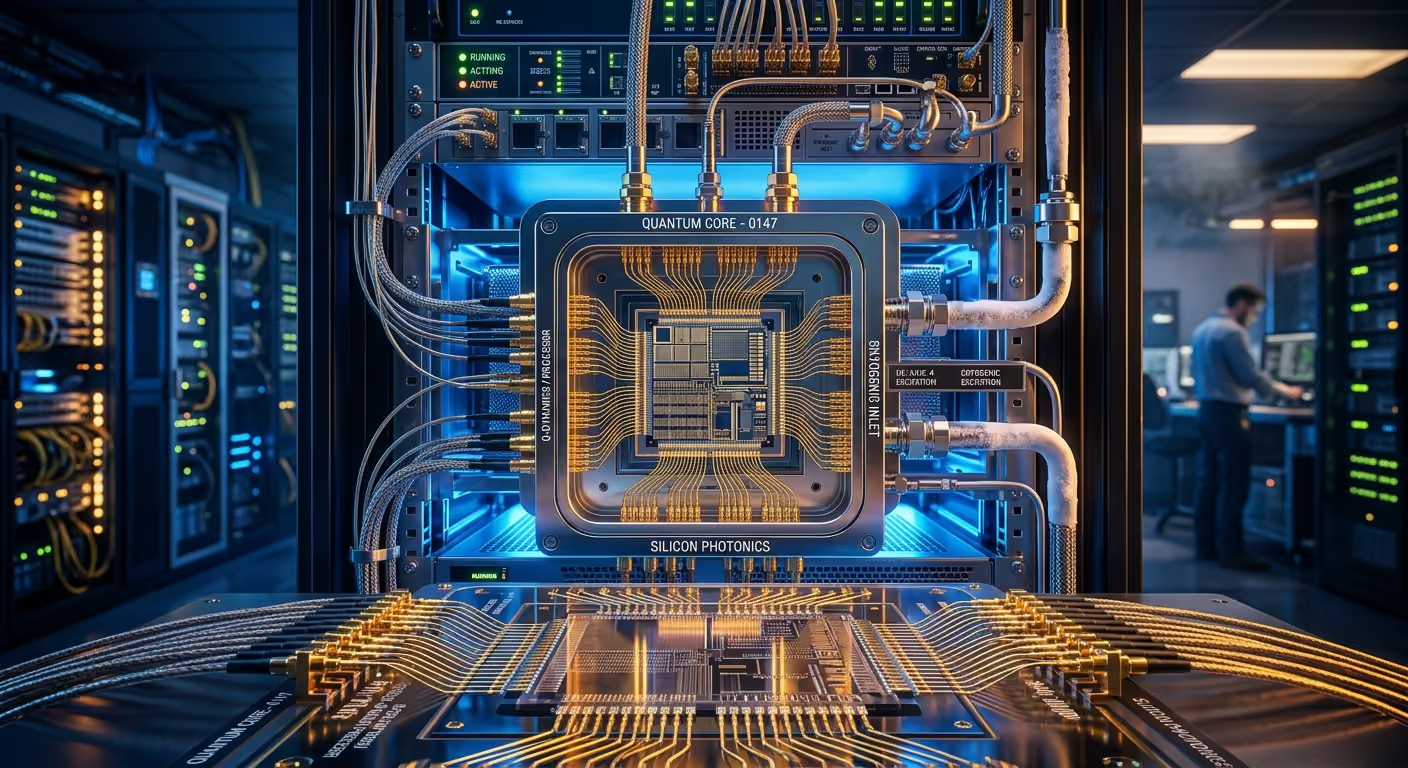
In a major policy move, the United States Department of Energy (DOE) has officially launched a 215 million dollar funding push designed to make quantum computers scientifically useful by 2028. This program represents a highly targeted shift in federal strategy. Rather than funding broad exploratory research, the DOE is focusing resources on bridging the gap between noisy intermediate-scale quantum (NISQ) systems and early fault-tolerant machines. The goal is to deliver tangible computational advantages for complex scientific workloads, including chemical simulations, materials design, and high-energy physics modeling, within the next twenty-four months.
The Maryland Quantum Corridor: Microsoft and Riverlane Set Up Shop
While federal dollars flow from Washington, the state of Maryland is rapidly consolidating its position as the premier geographic hub for fault-tolerant quantum engineering.
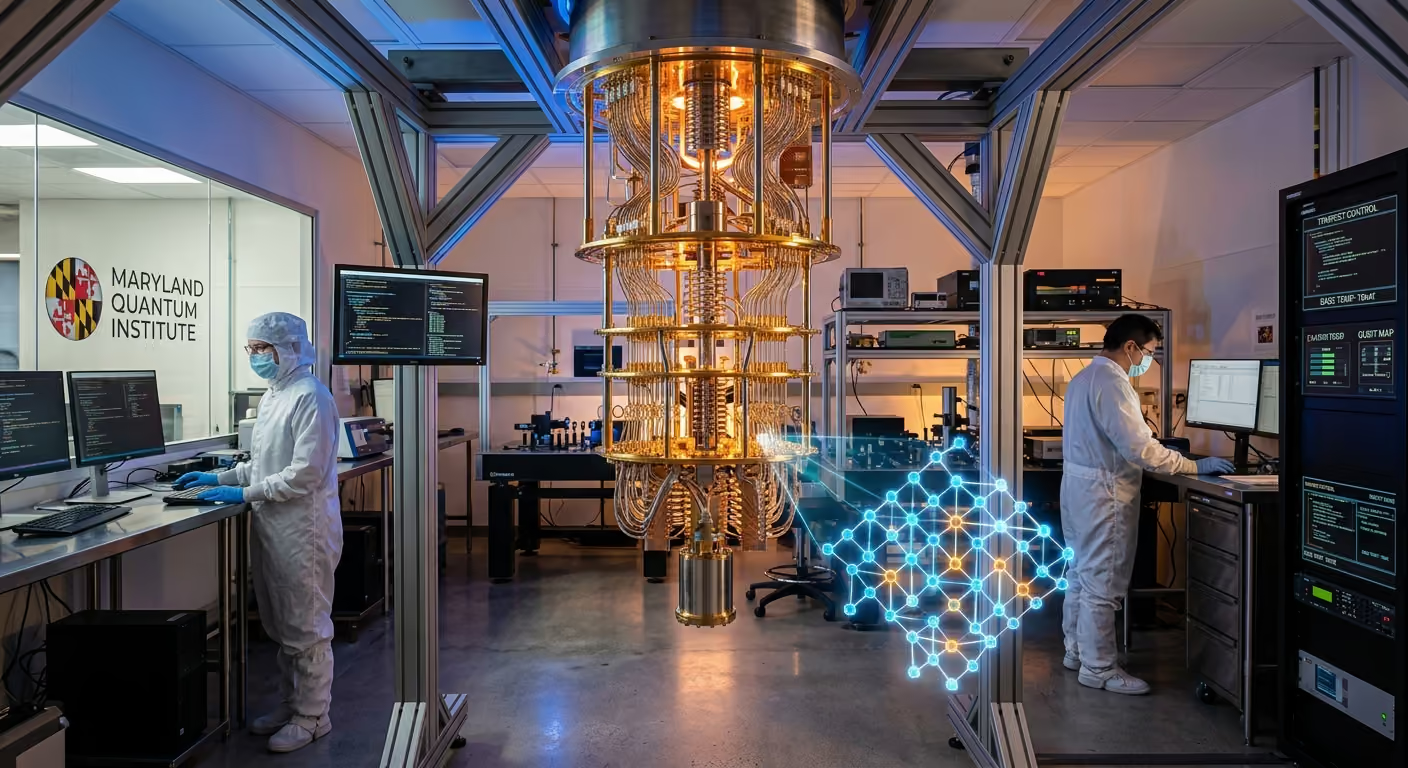
In a landmark collaboration, Microsoft has announced it is giving the Defense Advanced Research Projects Agency (DARPA) direct access to its proprietary Majorana hardware system. This partnership coincides with the opening of Microsoft's new Maryland Quantum Research Center, a facility dedicated to testing topological qubit designs that inherently protect quantum information from environmental noise. By collaborating with DARPA, Microsoft aims to accelerate the validation of its unique topological architecture, which many experts view as a dark horse candidate for large-scale, low-overhead error correction.
Strengthening this regional ecosystem further, prominent quantum error correction (QEC) pioneer Riverlane has officially established its new United States headquarters in Maryland. Riverlane, which specializes in the critical decoder hardware and software layers that detect and correct qubit errors in real time, plans to leverage the local talent pool and proximity to federal research labs to accelerate its integration partnerships with leading hardware developers.
Germany Commits €122 Million to Qudora for a 1,000-Qubit Processor
Across the Atlantic, European sovereign investments are matching the pace of US initiatives. The German government has selected a consortium led by QUDORA Technologies for a massive 122 million euro project. The primary mandate of this funding is to design and build a scalable, 1,000-qubit quantum computer. QUDORA, which focuses on advanced ion-trap architectures utilizing integrated waveguide structures, plans to bypass traditional optical alignment bottlenecks to deliver a highly stable, high-fidelity processor capable of executing complex quantum algorithms at scale.
Meanwhile, broader European software integration is progressing. France's Alternative Energies and Atomic Energy Commission (CEA) has announced plans to test Alice & Bob's specialized cat-qubit quantum software directly on its supercomputers. This initiative highlights a growing trend of integrating quantum software emulators and hardware accelerators directly into traditional high-performance computing (HPC) environments.
South Korea's Dual-Track Sovereign Strategy and Global Deployments
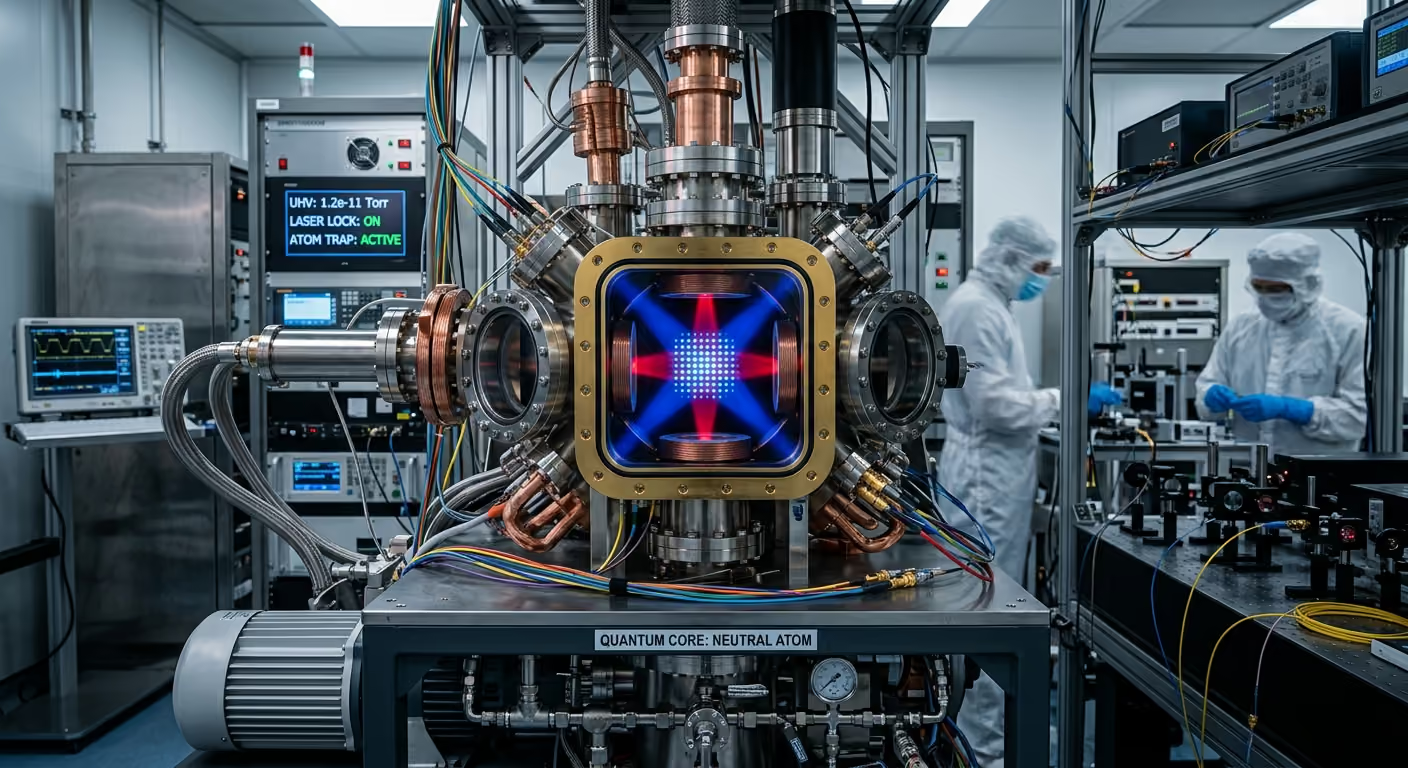
South Korea has unveiled an ambitious independent roadmap to develop native quantum computers by 2029. To mitigate technological risks, the government is pursuing a dual-track hardware strategy, simultaneously investing in superconducting and neutral-atom platforms. Rather than relying on foreign supply chains, South Korea intends to build its own end-to-end quantum infrastructure, a move highlighted by its newly minted bilateral quantum partnership with France to co-develop algorithms and hardware protocols.
In the commercial sector, hardware deployments are expanding to new regions. Finnish-German quantum leader IQM has officially shipped its first quantum computer to Brazil's Eldorado Research Institute, establishing a critical foothold in South America's emerging deep-tech ecosystem.
On the performance front, IonQ has published fresh research demonstrating up to a 14.6% gain in efficiency for complex engineering workloads. This announcement comes on the heels of IonQ's new deployment partnership with NVIDIA, which integrates IonQ's hardware with NVIDIA's quantum simulation platforms to streamline hybrid classical-quantum workflows.
The Bottom Line
- Targeted Timelines: The US DOE's 215 million dollar program sets a clear deadline of 2028 for quantum computers to prove scientific utility, shifting the industry focus from qubit counts to practical work done.
- Geographic Clusters: Maryland is emerging as a critical quantum corridor, anchored by Microsoft's new Majorana facility and Riverlane's US headquarters.
- Sovereign Initiatives: Germany's 122 million euro commitment to Qudora and South Korea's dual-track 2029 roadmap show that nations are treating quantum capabilities as vital sovereign infrastructure.
- High-Fidelity Milestones: Researchers have successfully simulated near-error-free qubit coupling with 99.9% fidelity, a crucial metric as systems transition from NISQ to fault-tolerant designs.
Quantum Computing Fun Fact: In a major leap for quantum acoustics, researchers at Stanford University recently observed the first real-time quantum jump in sound. By measuring individual phonons, the basic units of vibrational energy, in an acoustic resonator, scientists are opening the door to phononic quantum computing. In this architecture, sound waves instead of light particles are used to store and process quantum information, offering incredibly long coherence times.
Stay Connected for Weekly Quantum Intelligence
Follow us to get the latest breaking quantum computing reports and technical analysis delivered weekly.
Aibots Sdn Bhd | [Beyond Future]