Japan Launches Operational 'Shunkai' Neutral-Atom Computer as NSF Injects $290 Million into US Quantum Infrastructure
Today, August 27, 2026, marks another monumental week for quantum progression as the global landscape shifts from localized manufacturing blueprints to working full-stack hardware deployments and massive national research investments. Over the last seven days, the industry has witnessed significant diversification in hardware architectures, a multi-million-dollar surge in public funding, and critical corporate consolidations.
Japan's Neutral-Atom Breakthrough: Shunkai Goes Live
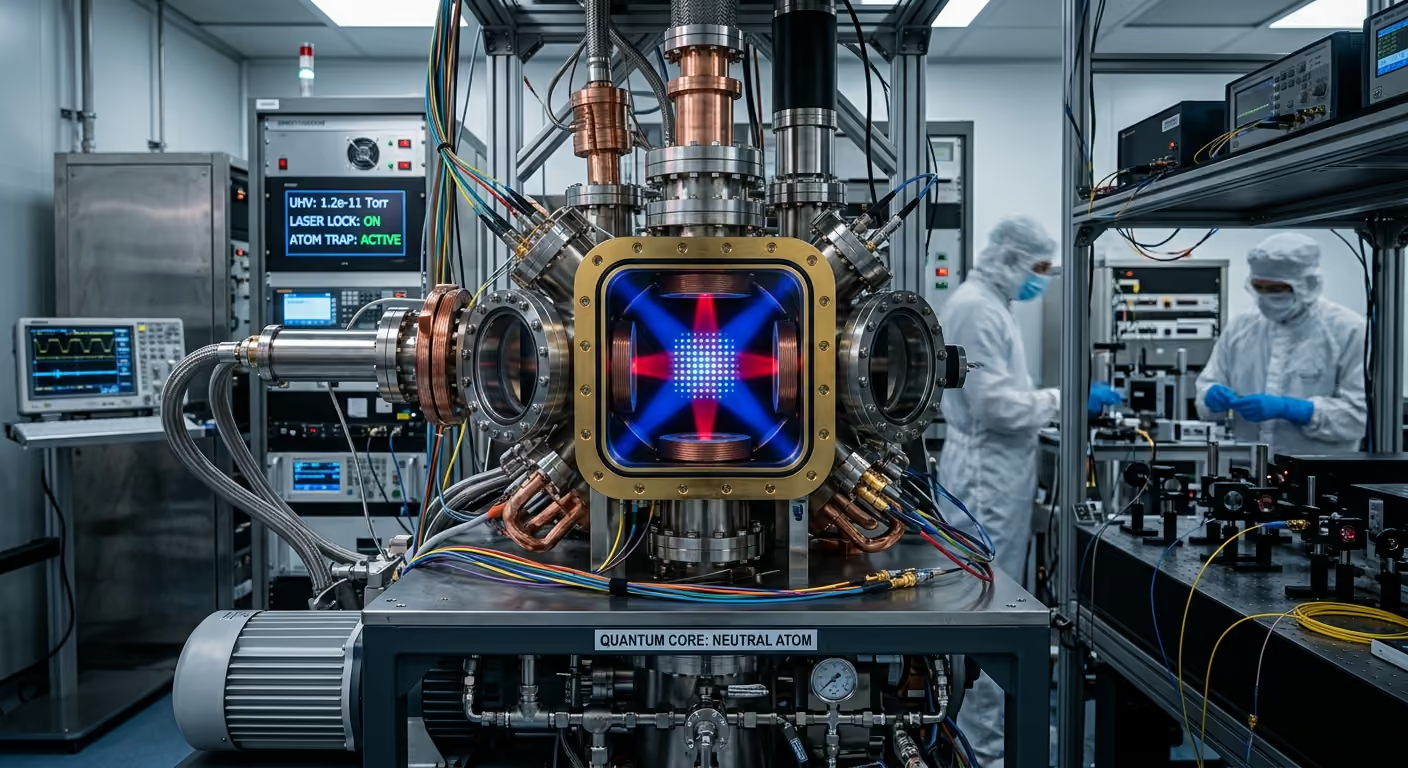
In a major challenge to superconducting dominance, Infleqtion, in collaboration with Japan's Moonshot Program, has announced that "Shunkai," the nation's first full-stack neutral-atom quantum computer, is now fully operational. Neutral-atom systems, which use lasers to trap and manipulate individual neutral atoms in optical tweezers, are increasingly seen as a highly scalable alternative to cryogenic superconducting processors. The launch of Shunkai cements Asia as a rapidly accelerating battleground for global quantum leadership, proving that alternative architectures are moving past pure physics experiments into functional, full-stack systems.
United States Injects $290 Million into Eight Research Hubs
To counter international milestones, the U.S. National Science Foundation (NSF) has committed 290 million dollars to advance quantum science across eight specialized research institutes. This massive capital injection is explicitly aimed at transitioning quantum technologies from the academic lab to field-ready applications.
Key academic centers are leading these efforts. The University of Colorado Boulder and UC Berkeley have each been awarded 37.5 million dollars to push the frontiers of quantum computing. Meanwhile, UCLA computer scientists Jason Cong and Jens Palsberg are taking on vital co-leadership roles within these newly funded networks, bringing 75 million dollars of the collective efforts under the guidance of top-tier hardware-software integration specialists. Princeton University and the Illinois-led Hybrid Quantum Architectures and Networks (HQAN) have also secured renewals to cultivate a workforce capable of operating the next generation of hybrid computers.
Corporate Consolidation and Cryogenic Scaling
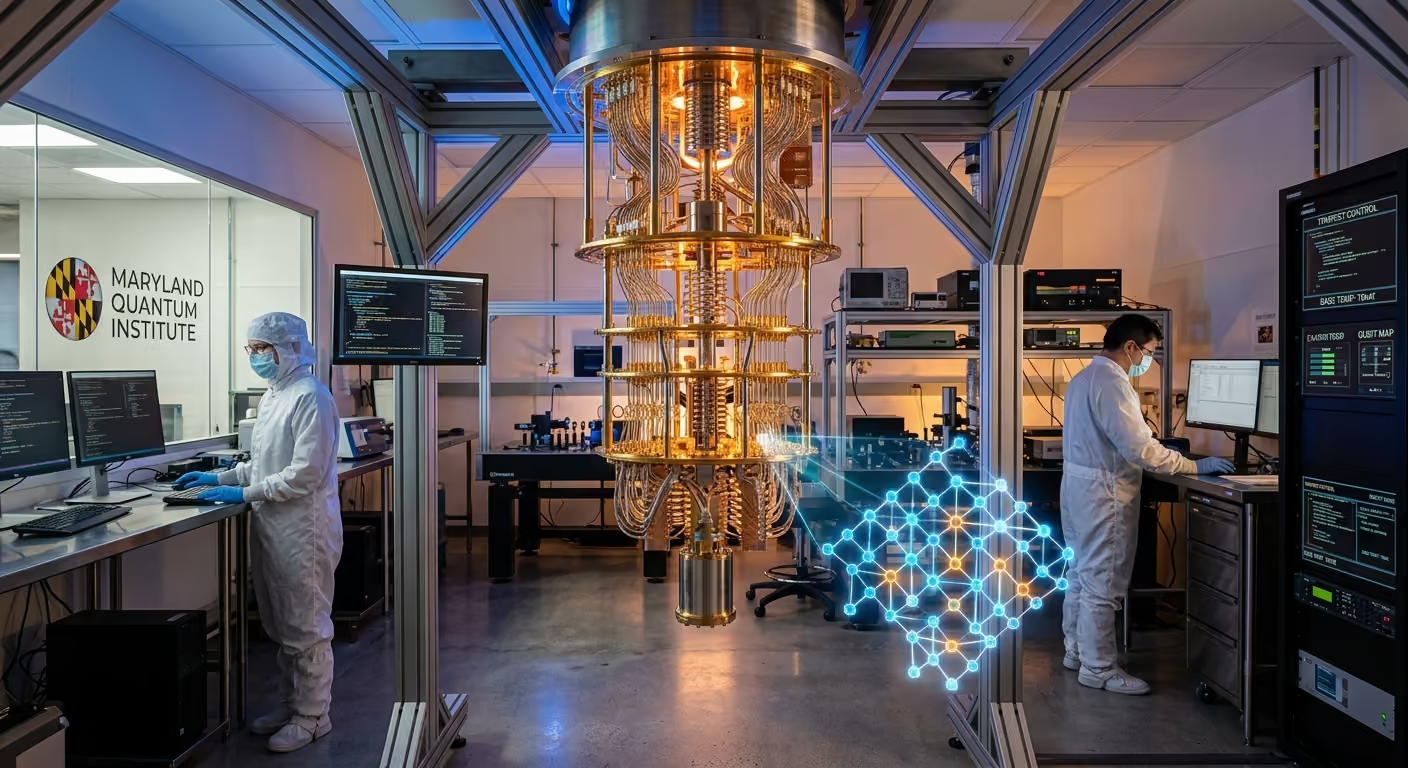
On the commercial front, IBM has finalized its acquisition of HRL Laboratories, a move that bolsters its patent portfolio in semiconductor-based quantum technologies. Alongside the acquisition, IBM revealed new details about its advanced, ultra-large-scale cryogenic systems. These next-generation cooling systems are designed to overcome the physical bottlenecks of cooling thousands of physical qubits, addressing the critical thermal challenges of scaling quantum hardware.
Not far away, Google has quietly expanded its quantum research presence in Goleta, California. The tech giant acquired a new 32.5 million dollar campus, highlighting its commitment to expanding physical hardware facilities near its existing quantum laboratories.
International Deployments: India and the United Kingdom
The democratization of quantum hardware is also picking up pace globally. In India, quantum software and hardware developer QpiAI has signed a memorandum of understanding with Pandit Deendayal Energy University (PDEU) in Gujarat. Under this partnership, QpiAI will install an 8-qubit quantum computer to establish a new Western India Quantum Centre of Excellence.
Meanwhile, in Europe, UK-based FormationQ has partnered with the STFC Hartree Centre. This initiative is designed to accelerate the practical adoption of quantum-classical AI algorithms, giving British businesses a direct pipeline to test quantum optimization on high-performance computing clusters.
The Bottom Line
- Neutral-Atom Progress: Japan has officially brought "Shunkai" online, proving that neutral-atom systems are ready for full-stack, operational tasks.
- Massive Public Investment: The NSF has distributed 290 million dollars across eight U.S. research institutes to fast-track laboratory prototypes into industrial-ready systems.
- Physical Footprint Expansion: Google spent 32.5 million dollars on a Goleta campus expansion, while IBM acquired HRL Laboratories and advanced its cryogenic system research.
- Quantum Computing Fun Fact: While standard qubits are highly sensitive to physical disturbances, researchers at the FAMU-FSU College of Engineering have successfully designed a magnetically levitated qubit. By floating the qubit in a vacuum, they aim to eliminate physical contact entirely, cutting decoherence and decay rates in half.
Stay Connected for Weekly Quantum Intelligence
Follow us to get the latest breaking quantum computing reports and technical analysis delivered weekly.
Aibots Sdn Bhd | [Beyond Future]