Google Slashes Quantum Error Rates, D-Wave Lands in Italy, and IBM Harnesses AI for QEC Chips
As of October 22, 2026, the global quantum computing sector continues its relentless march from theoretical physics into high-performance industrial infrastructure. Building on last week's massive defense allocations and modular trapped-ion expansion, this week saw game-changing breakthroughs in quantum error correction fidelity, automated chip design, and international hardware deployments.
Google Slashes Critical Quantum Error Rates by 40X
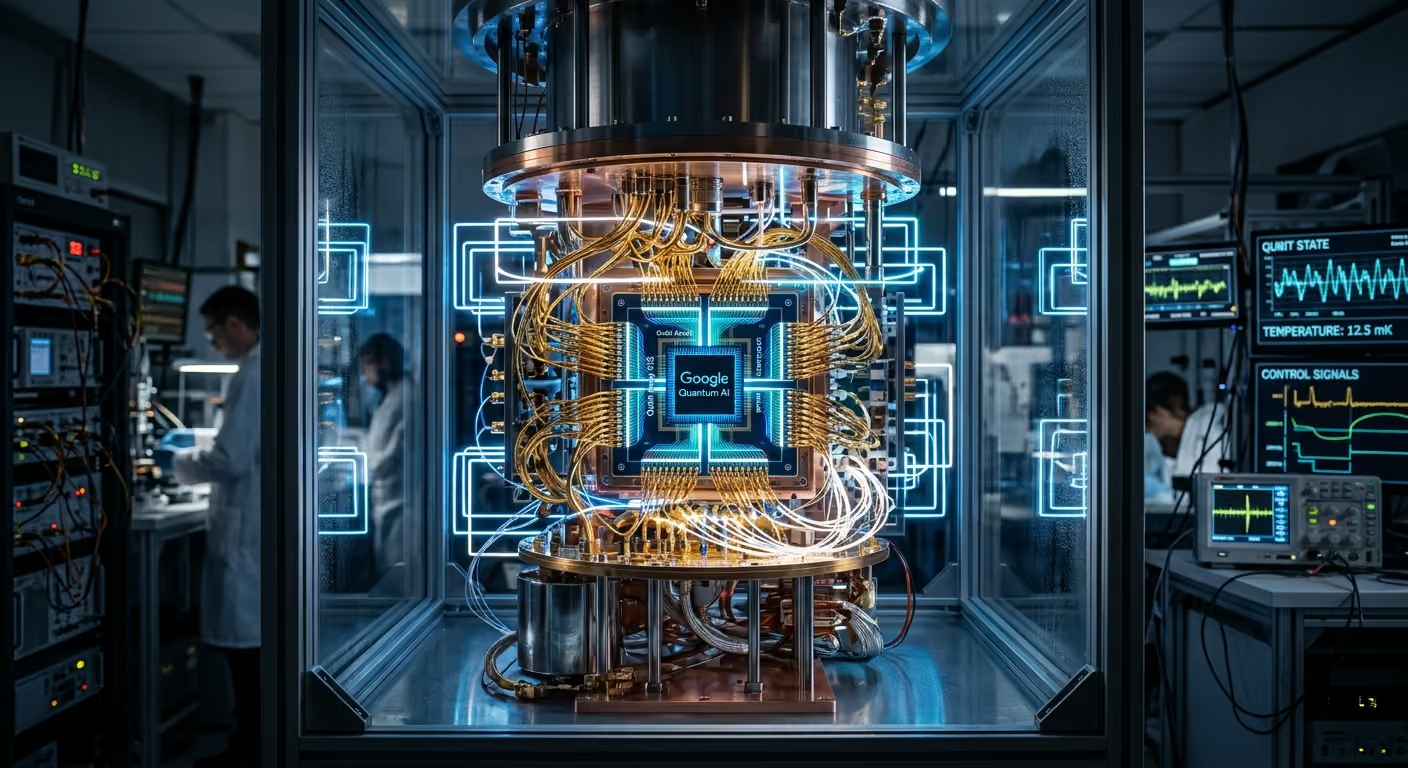
In a landmark paper, Google Quantum AI announced a major hardware milestone by breaking open a persistent bottleneck in superconducting quantum systems. By optimizing quantum gate operations and logical qubit configurations, Google researchers successfully reduced a key physical error rate by a factor of 40. This dramatic reduction significantly lowers the threshold required for sustained logical qubit operations, bringing real-world, fault-tolerant quantum computing closer to commercial reality.
D-Wave Delivers Italy's First Annealing Quantum Computer
D-Wave Quantum has officially delivered its flagship Advantage2 quantum annealing system to Italy as part of a strategic partnership with SQT. This deployment marks Italy's first operational industrial quantum annealer and supercomputer hub. Designed to tackle complex combinatorial optimization problems in logistics, finance, and advanced manufacturing, the Advantage2 platform provides European enterprise partners with direct access to high-qubit annealing hardware.
IBM Automates QEC Decoder Chip Design with AI Agents
Targeting the massive computational overhead of real-time quantum error correction (QEC), IBM Research unveiled an automated design framework using Open AI agent factories. The system automates the architectural design of specialized QEC decoder chips, reducing inference execution costs by 11.5 times. By leveraging autonomous AI agents to design ultra-fast hardware decoders, IBM is solving the microsecond latency bottleneck required to correct physical qubit errors on the fly.
NYC Partners with NYU for Quantum Fabrication Hub
New York City has announced a pioneering public partnership to build a state-of-the-art NYU Quantum Fabrication Facility. Announced by municipal leaders, the initiative gives the city a direct stake in emerging deep-tech fabrication infrastructure. The facility will focus on scaling quantum microelectronics, novel materials, and specialized qubit packaging, establishing New York City as a major metropolitan hub for commercial quantum hardware manufacturing.
The Bottom Line
- Error Correction Surge: Google's 40x error rate reduction demonstrates that physical hardware noise is being systematically conquered.
- AI-Driven Hardware: IBM's 11.5x cost reduction in QEC decoder design shows how AI agent workflows are directly accelerating quantum hardware development.
- European Expansion: D-Wave's Advantage2 installation in Italy cements quantum annealing as a primary tool for European industrial optimization.
- Quantum Computing Fun Fact: Real-time Quantum Error Correction decoders must analyze physical qubit syndrome data and calculate corrections within sub-microsecond timeframes, faster than the coherence decay time of the physical qubits themselves.
Stay Connected for Weekly Quantum Intelligence
Follow us to get the latest breaking quantum computing reports and technical analysis delivered weekly.
Aibots Sdn Bhd | [Beyond Future]