Asian Quantum Surge: South Korea Unveils 50-Qubit Processor, Singapore Commits $300M, and IBM Expands Sovereign Networks
As of today, October 08, 2026, the trajectory of quantum development is moving rapidly past theoretical milestones and straight into sovereign hardware deployment. This week, major state investments in Asia and expanded corporate-academic alliances in India highlight a global race to secure localized, fault-tolerant supercomputing ecosystems.
South Korea and Singapore Lead Asian Quantum Surge
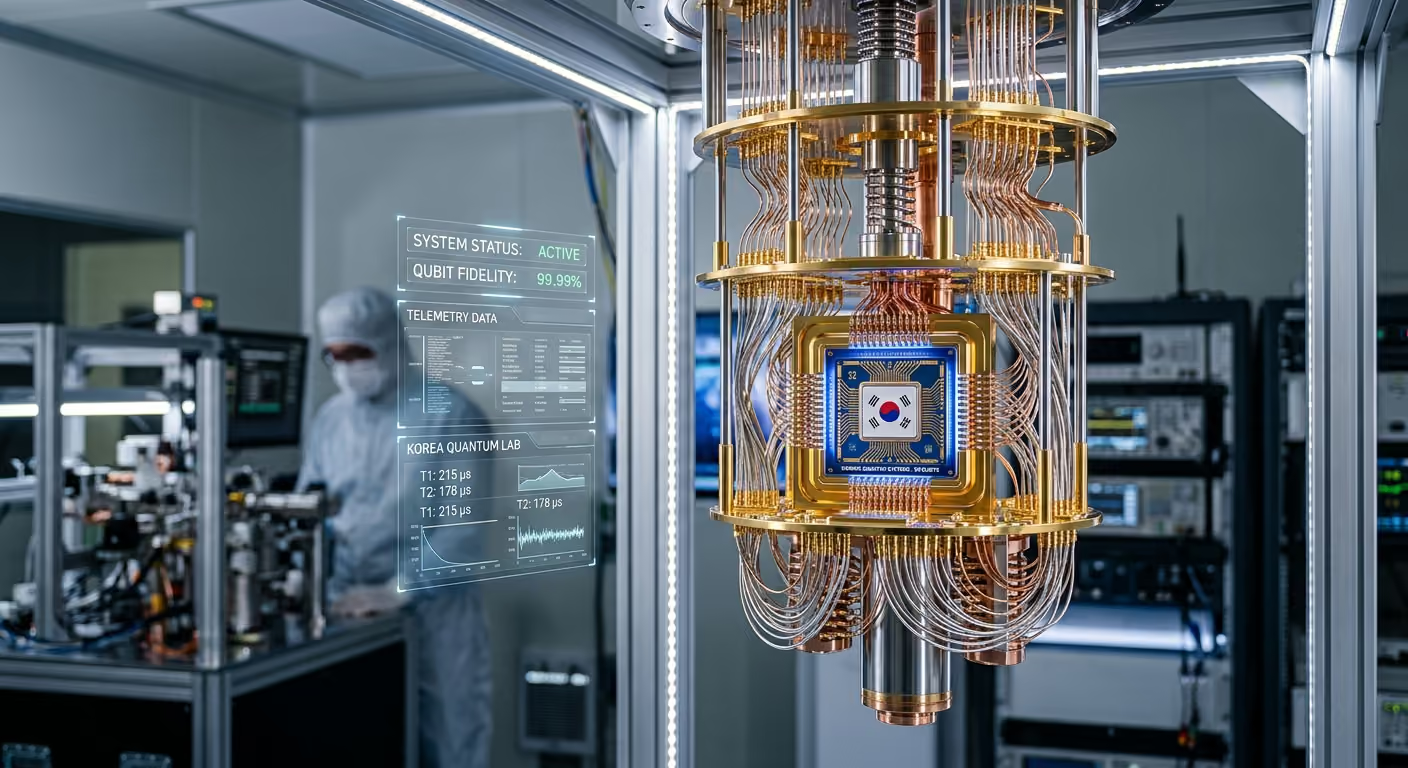
In a landmark hardware release, South Korea has officially unveiled its domestic 50-qubit quantum computer. The state-backed initiative has set an aggressive scaling roadmap, targeting a 100-qubit system by 2029. This release cements South Korea's position as a direct contender in the physical hardware space, moving beyond simulation toward true cloud-accessible quantum processors.
Not far behind, Singapore is doubling down on its infrastructure and brain trust. The Singapore Economic Development Board (EDB) has announced a massive funding commitment of approximately 300 million Singapore dollars (around 220 million USD) dedicated entirely to quantum technology research and global talent acquisition. This capital injection is designed to secure Singapore's position as Southeast Asia's primary quantum commercial hub, funding localized research groups and attracting elite international hardware specialists.
Sovereign Supercomputing: IBM Expands Indian Footprint
Sovereign technology infrastructure has taken center stage in South Asia. IBM has announced a significant expansion of its research partnerships in India, teaming up with the Indian Institute of Technology Bombay (IIT Bombay) and the Indian Institute of Science (IISc). This collaboration focuses directly on quantum-centric supercomputing and the advancement of sovereign AI frameworks. By integrating classical high-performance computing (HPC) with quantum hardware, the initiative aims to build resilient computing networks that do not rely on foreign cloud pipelines.
This academic expansion aligns perfectly with local policy shifts. The state government of Maharashtra has launched the "CM-SRISTHI" scheme, a strategic technology initiative designed to accelerate local research in AI, quantum computing, and advanced semiconductor fabrication. By funding regional centers of excellence, the scheme ensures that India's industrial centers are physically prepared to adopt next-generation computing hardware.
Hardware Milestones: Low-Error States and Quantum Supply Chains
Beyond national policies, hardware developers are achieving impressive physical benchmarks. Researchers have announced a major error correction milestone, successfully preparing quantum Bell states with extremely low error rates approaching one in ten thousand (a 99.99% fidelity rate). This achievement brings physical qubits closer to the strict mathematical thresholds required for continuous topological error correction.
On the commercial manufacturing front, semiconductor giant Infineon and developer ZuriQ have expanded their hardware collaboration. The partnership is focused on scaling up ion-trap quantum processors by leveraging Infineon's existing microfabrication and packaging technologies, bypassing custom manufacturing bottlenecks.
Meanwhile, in the United States, D-Wave has partnered with the University of Arkansas Sam M. Walton College of Business to launch the Quantum Supply Chain Initiative. This specialized project will explore how quantum annealing can optimize complex logistics and distribution networks, proving that quantum applications are already finding practical utility in global commerce.
The Bottom Line
- Sovereign Ecosystems: South Korea's 50-qubit processor and Singapore's 300 million dollar funding demonstrate that medium-sized tech powers are actively securing physical quantum independence.
- Academic Networks: IBM's deep integrations with IIT Bombay and IISc, combined with Maharashtra's CM-SRISTHI policy, are establishing India as a critical hub for hybrid quantum-classical supercomputing.
- Fidelity Milestones: Preparing Bell states with a 99.99% fidelity rate brings the industry closer to the fault-tolerant architectures needed for commercial-scale algorithms.
Quantum Computing Fun Fact: The ultra-low error rates achieved this week in Bell state preparation mean that scientists are now closer than ever to the physical error limits required to run continuous, large-scale topological error correction without the systems collapsing from environmental noise.
Stay Connected for Weekly Quantum Intelligence
Follow us to get the latest breaking quantum computing reports and technical analysis delivered weekly.
Aibots Sdn Bhd | [Beyond Future]