National Roadmaps and Silicon Spin: US Unveils Error-Correction Blueprint as Malaysia Welcomes First Quantum Hardware Base
Today, October 01, 2026, marks a pivotal moment of transition in the global quantum landscape. Since last week's funding announcements, the narrative has shifted from raw physical qubit counts to the underlying physical infrastructure and long-term blueprints required to make fault tolerance a reality.
The US Lays Down the Error-Correction Blueprint
In a landmark publication, the United States Department of Energy has released its highly anticipated national quantum computing roadmap. This comprehensive strategy, led by the Scientific Computing Advisory Committee (SCAC) subcommittee, charts a direct course to achieve stable, error-corrected quantum machines. Instead of focusing solely on abstract algorithm designs, the roadmap prioritizes building out physical co-design centers and establishing uniform scaling benchmarks across superconducting, neutral atom, and trapped ion platforms.
Simultaneously, the National Science Foundation (NSF) has injected 75 million dollars in fresh grants into research institutes co-led by the University of California, Los Angeles (UCLA). These funds are aimed specifically at translating basic quantum science into reliable hardware components. This federal backing aligns with the opening of several massive physical research spaces. Oak Ridge National Laboratory (ORNL) has unveiled a brand-new, 100,000-square-foot facility designed to push the frontiers of quantum computing and advanced battery technologies.
Further west, the state of New Mexico is establishing itself as an industrial quantum nexus. The newly opened Roadrunner Quantum Lab in Albuquerque features a 35,000-square-foot facility. This hub immediately links national laboratories, private ventures, and academic startups, creating a collaborative hardware makerspace to prototype, test, and package next-generation quantum chips.
Silicon Spin and Quantum Dots Gain Traction
As the US constructs physical facilities, France is accelerating its commercial silicon hardware efforts. The French Alternative Energies and Atomic Energy Commission (CEA-Leti) and developer Quobly have officially strengthened their existing partnership. Their expanded mandate is to accelerate the production of spin qubits on silicon. By using existing semiconductor manufacturing techniques, the collaboration aims to bypass the custom manufacturing bottlenecks that plague other qubit modalities, offering a faster route to mass-producing chips with millions of physical qubits.
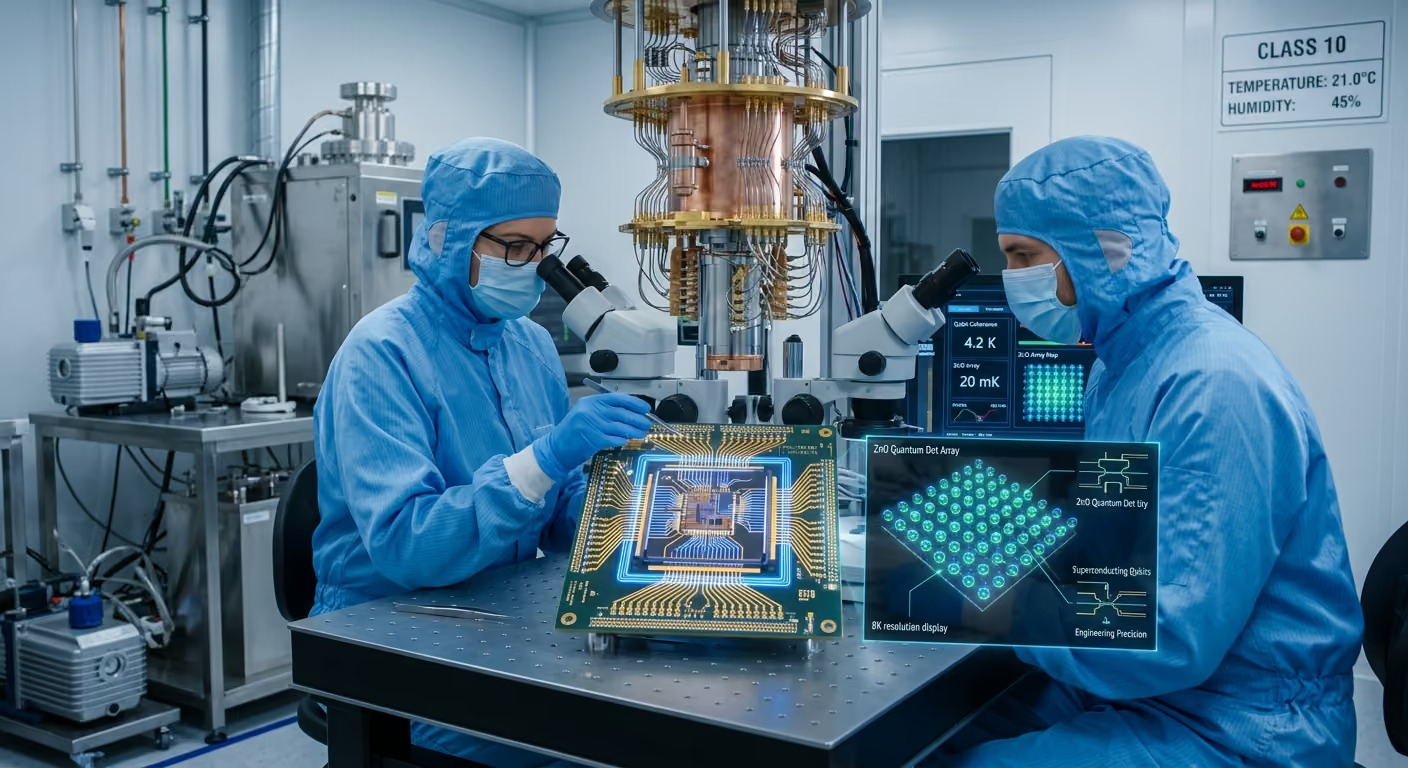
Complementing these industrial silicon developments, academic researchers have reported a hardware milestone using zinc oxide quantum dots. Traditionally, environmental quantum noise destroys fragile superposition states, but by leveraging zinc oxide nanocrystals, researchers have successfully demonstrated coherent state control. This material breakthrough offers a robust alternative to conventional silicon or gallium arsenide, presenting a high-temperature pathway to manage quantum noise at scale.
Global Alliances and Southeast Asia's Emergence
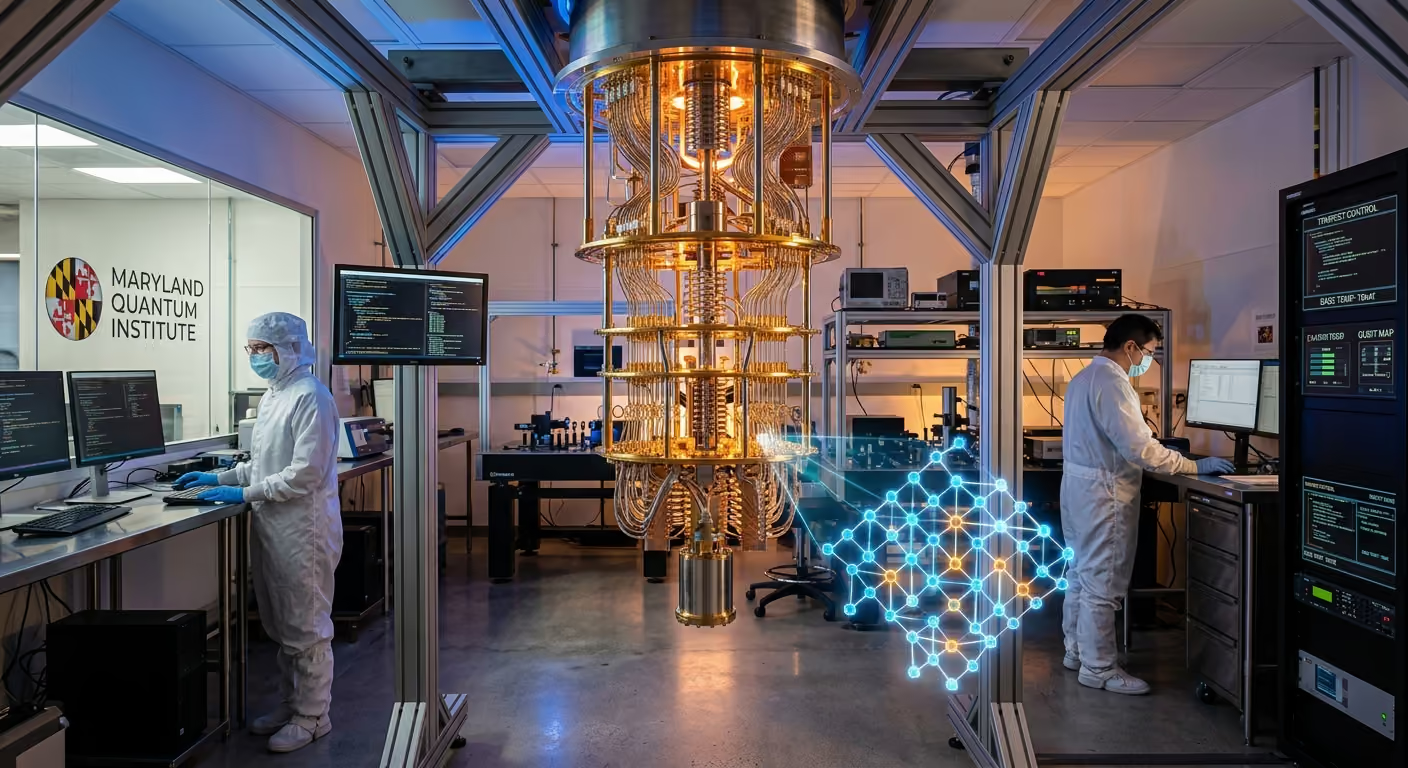
This week also marks a major geopolitical shift as Southeast Asia establishes its own quantum hardware footprint. Singapore-based quantum startup AQSolotl has announced the opening of its new research and development base within Malaysia's UTM Technovation Park in Johor. This facility marks Malaysia's very first dedicated quantum hardware development center, representing a major geographic expansion for quantum manufacturing beyond traditional Western and East Asian hubs.
Meanwhile, international distribution and bilateral agreements are accelerating across Europe and the Middle East. Qatar's Hamad Bin Khalifa University (HBKU) has secured a strategic agreement to gain direct access to the advanced Dirac-3 quantum system, establishing a solid footprint for quantum simulation in the Gulf region. In North America, the University of Waterloo has helped broker a new bilateral partnership between Canada and Italy, establishing a joint research channel to co-develop quantum communication and sensing protocols.
The Bottom Line
- National Roadmaps: The newly released US national roadmap shifts federal priority from raw exploration to targeted, error-corrected quantum system architectures.
- Physical Footprints: With UCLA's 75 million dollar NSF grants, ORNL's 100,000-square-foot facility, and New Mexico's 35,000-square-foot Roadrunner Quantum Lab, physical laboratory space is scaling rapidly to match theoretical progress.
- Global Expansion: AQSolotl's expansion into Malaysia and Qatar's Dirac-3 deployment demonstrate that quantum hardware is no longer confined to a handful of superpowers.
- Silicon Alliances: The expanded CEA-Leti and Quobly alliance showcases Europe's commitment to leveraging existing semiconductor foundries for silicon spin qubits.
Quantum Warning Fact: EU regulators have issued a fresh warning regarding Bitcoin's cryptographic vulnerability. They note that the quantum threat to standard public-key cryptography could materialize much sooner than expected, potentially predating the full commercial viability of large-scale quantum computers. This timeline is driving financial institutions to accelerate their transition to post-quantum cryptography (PQC) standards immediately.
Stay Connected for Weekly Quantum Intelligence
Follow us to get the latest breaking quantum computing reports and technical analysis delivered weekly.
Aibots Sdn Bhd | [Beyond Future]