IBM Buys HRL Laboratories and Israel Launches National Hub as Quantum Consolidation Accelerates
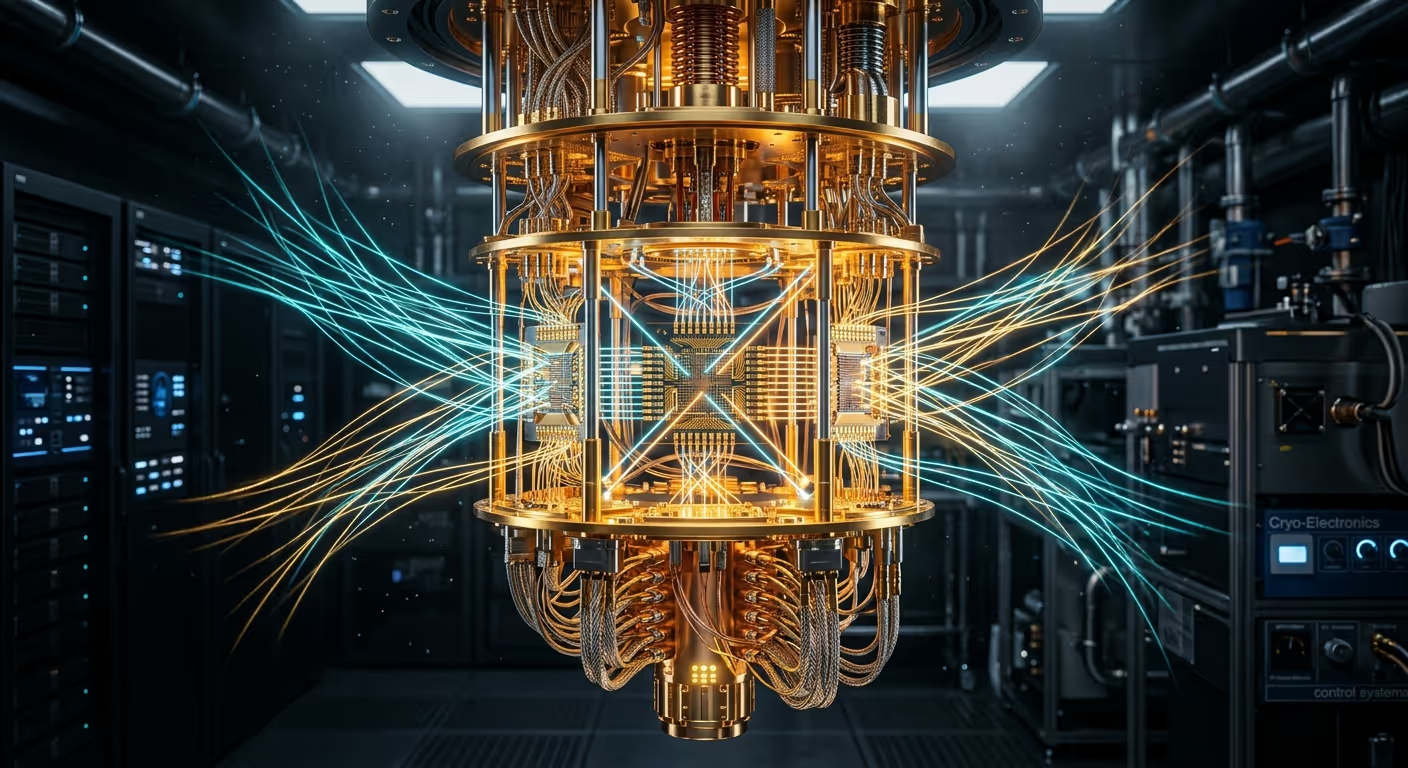
Reports as of today, July 23, 2026, show that the global quantum computing trajectory is shifting gear from laboratory experimentation into aggressive corporate consolidation and state-backed scaling.
IBM Doubles Down on Silicon Spin Qubits with HRL Laboratories Acquisition
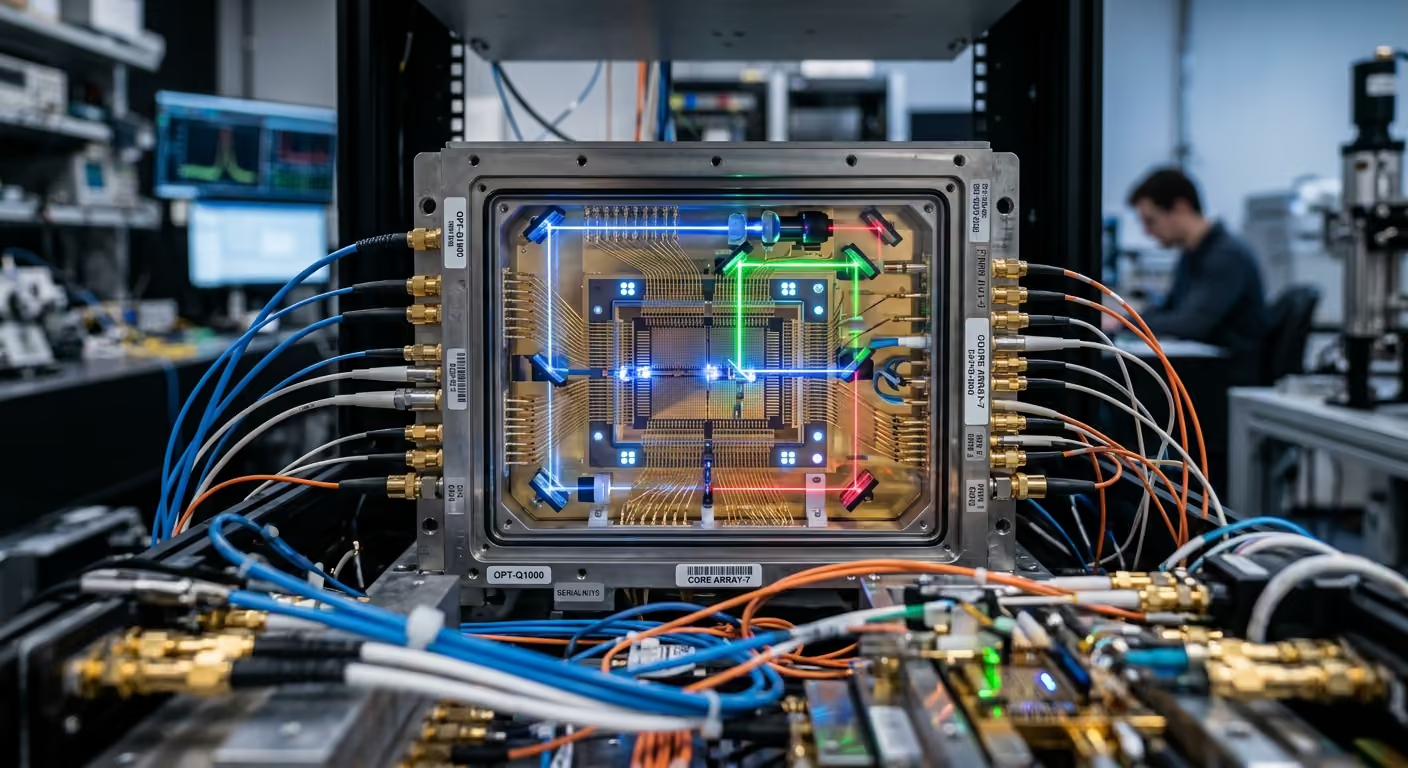
In one of the most significant consolidation moves of the year, tech giant IBM has announced its acquisition of HRL Laboratories. This strategic buyout signals a major shift in IBM's developmental roadmap, establishing a two-track strategy that pairs its existing superconducting qubits with HRL's state-of-the-art silicon spin qubit technology. The acquisition is designed to accelerate IBM's ambitious technical milestone: achieving 100 million quantum operations by the year 2029. By absorbing HRL's intellectual property and specialized engineering talent, IBM aims to bypass several scaling roadblocks that have plagued single-architecture approaches.
Global Power Plays: Israel and Japan Unveil Massive State-Backed Initiatives
Governments worldwide are accelerating their national quantum roadmaps, seeking to establish domestic sovereignty over the next computing epoch. The Israel Innovation Authority has officially launched a national quantum computing research and development hub backed by a NIS 100 million (approximately 27 million US dollars) budget. The initiative is uniquely designed to force three distinct hardware architectures to compete directly, helping researchers evaluate which modality offers the most reliable path to error-corrected scale.
Meanwhile, in East Asia, the Japanese government has backed a major collaborative project uniting Hitachi, Intel, and the National Institute of Advanced Industrial Science and Technology (AIST). Funded by Japan's NEDO agency, this powerhouse alliance will develop next-generation silicon spin qubits using Intel's cutting-edge 18A chip manufacturing process, leveraging existing semiconductor fabrication infrastructure to dramatically lower production costs.
Millions in Funding: DARPA and the Department of Energy Fuel Hardware Milestones
The United States defense and energy sectors are injecting massive capital into next-generation quantum testing and hardware. PsiQuantum has secured a milestone 125 million dollar contract from the Defense Advanced Research Projects Agency (DARPA). The funding is earmarked to advance robust, independent testing of the company's fault-tolerant photonic quantum systems, verifying their viability for national security applications.
Simultaneously, quantum pioneer Infleqtion has secured three prestigious Genesis Mission research projects from the U.S. Department of Energy (DOE). The announcement triggered an 8.53 percent surge in Infleqtion's stock value. This momentum comes alongside Infleqtion's plans to deploy a fully fault-tolerant neutral-atom quantum computer at the Illinois Quantum Park in 2027.
From Cryogenics to the Room-Temperature Frontier
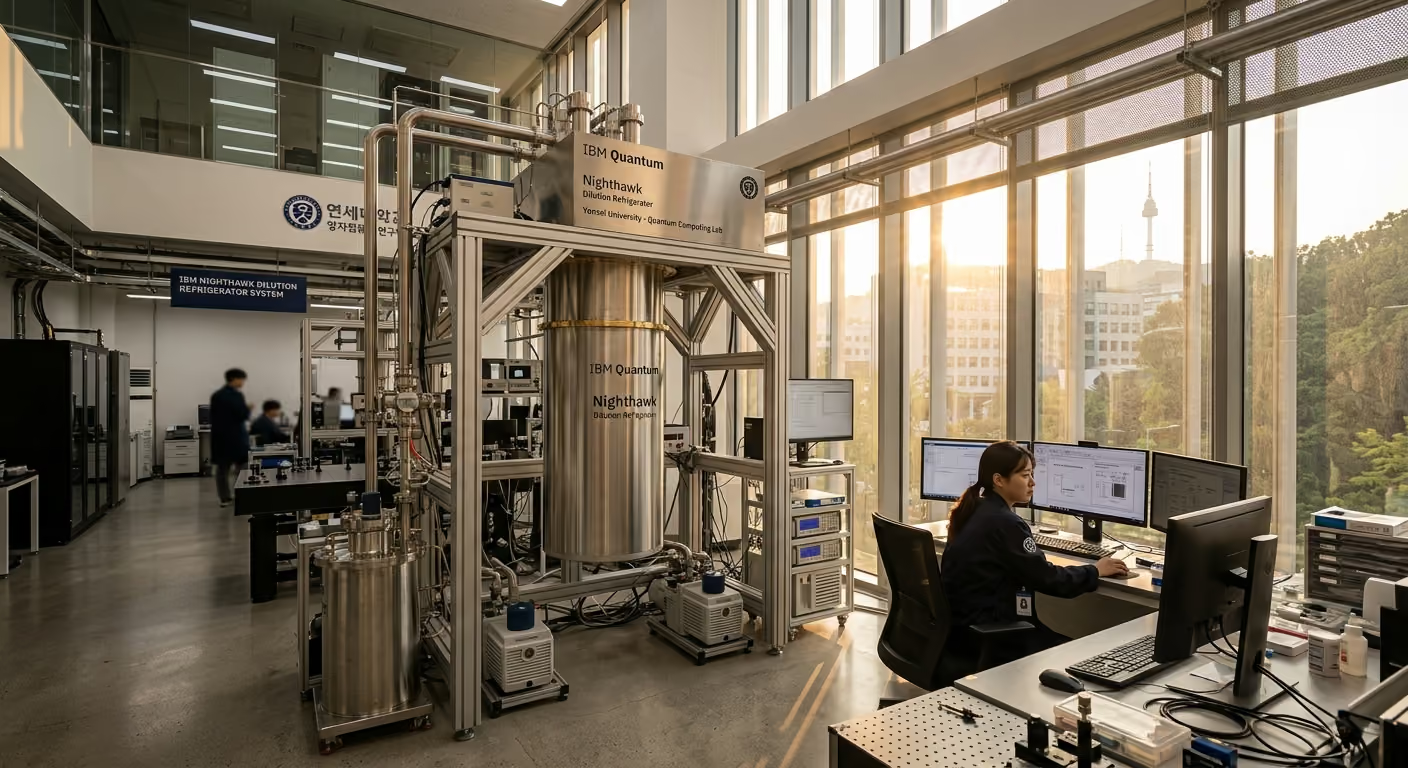
On the infrastructure front, the quantum ecosystem is tackling scaling challenges from two opposite angles. Start-up Zero Point Cryogenics opened a new Chicago hub to bolster regional cooling supply chains, while Interlune announced specialized cryogenic systems to secure and expand the global supply of Helium-3, an isotope critical for cooling quantum systems.
Conversely, three software and hardware engineers in Bengaluru, India, have built a start-up that claims to have developed a quantum computer capable of operating at room temperature. This development, if scaled, could bypass the restrictive and expensive cryogenic cooling arrays that currently limit the accessibility of quantum hardware, introducing a disruptive variable to the industry's physical footprint.
The Bottom Line
The quantum industry is undergoing a structural evolution where academic promise meets raw capital and industrial scaling. Large-scale corporate acquisitions, state-backed manufacturing initiatives, and massive defense-sector testing contracts are laying down the physical infrastructure needed for the next decade of commercial utility.
TL;DR Summary
- Strategic Acquisition: IBM has acquired HRL Laboratories to drive a dual-track hardware strategy, targeting 100 million operations by 2029.
- Sovereign Infrastructure: Israel has launched a NIS 100 million hub to test three competing architectures, while Japan partners with Intel and Hitachi to build qubits on the 18A process.
- Mega Contracts: PsiQuantum won a 125 million dollar DARPA contract, and Infleqtion secured three DOE grants ahead of its 2027 neutral-atom deployment.
- Diverse Horizons: Infrastructure innovations span from new Chicago cryogenic hubs to room-temperature start-up breakthroughs in Bengaluru.
If you want to stay ahead of the curve in this rapidly evolving sector, make sure to follow us for weekly updates and breaking quantum insights.
Stay Connected for Weekly Quantum Intelligence
Follow us to get the latest breaking quantum computing reports and technical analysis delivered weekly.
Aibots Sdn Bhd | [Beyond Future]