IBM Nighthawk Lands in South Korea as Sunlight-Driven Entanglement Shakes Quantum Physics
As of today, August 13, 2026, the global quantum computing sector is demonstrating incredible momentum, building on the structural error-correction breakthroughs of last week to deliver major regional hardware deployments and stunning discoveries in fundamental physics.
South Korea Secures Second IBM Nighthawk Processor
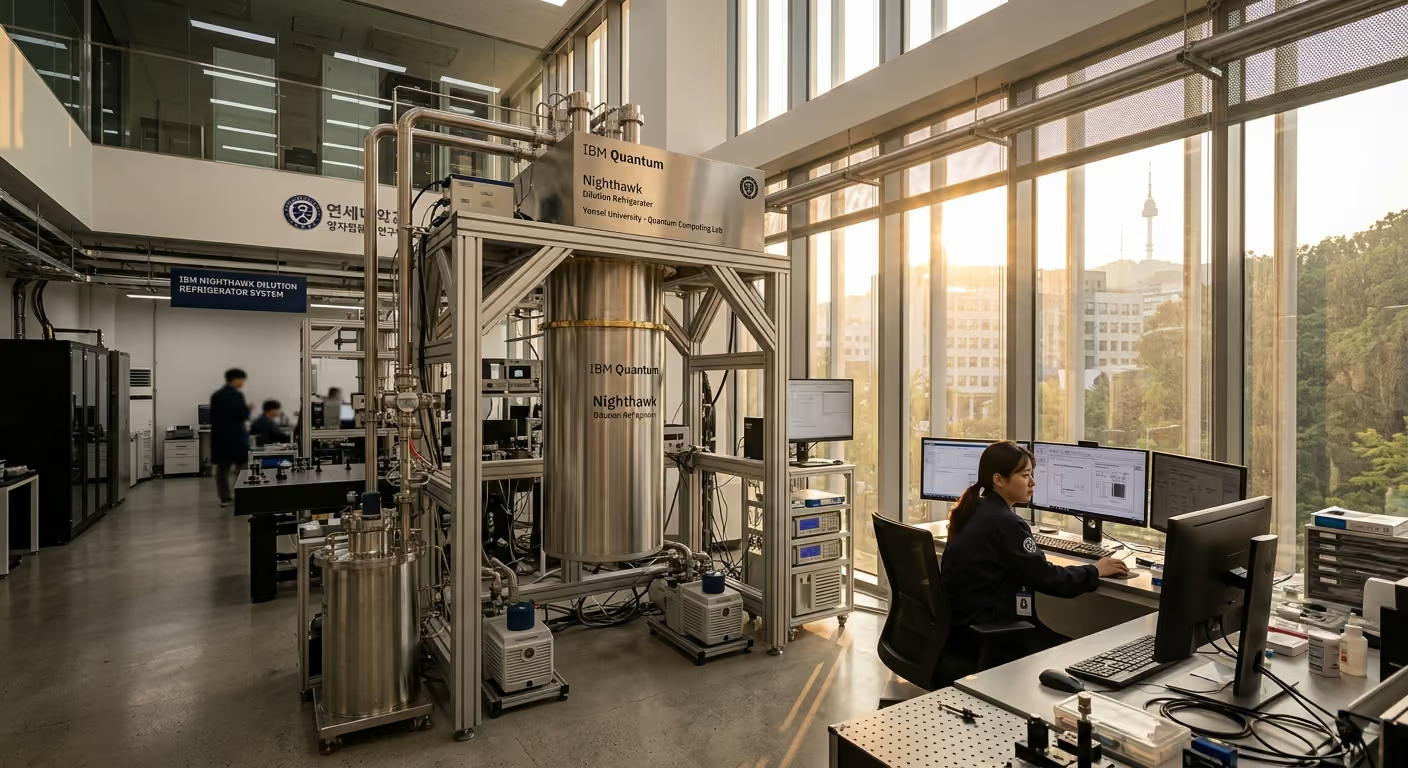
In a massive win for East Asia's deep-tech ecosystem, South Korea's Yonsei University has announced plans to install the world's second IBM Nighthawk quantum computer. This strategic deployment is projected to boost localized quantum computation speeds by 40 percent, offering a massive upgrade for both academic researchers and industrial giants looking to run complex molecular and financial simulations.
The installation of the IBM Nighthawk processor represents a critical turning point for South Korean industry. By having direct, high-speed quantum hardware on-site, local enterprises can bypass the latency issues associated with cloud-based quantum access. Yonsei University plans to use this computational leap to foster collaborations in materials science, pharmaceutical development, and supply-chain optimization, establishing the campus as a primary quantum hub for the ASEAN region and beyond.
Physics Shattered: Sunlight Entanglement Proven
For decades, physicists believed that generating quantum entanglement, the phenomenon Albert Einstein famously called spooky action at a distance, required highly controlled, power-intensive laboratory lasers. That paradigm has been completely shattered. A landmark study highlighted by ScienceDaily reveals that natural sunlight can create quantum entanglement in physical systems.
By proving that incoherent light from a star can induce coherent quantum states, researchers have opened up a brand new frontier for quantum sensing and environmental monitoring. This discovery has profound implications: future quantum sensors could theoretically operate using ambient light rather than expensive, heavy laser systems. It also simplifies the architecture required for space-based quantum communications, utilizing natural solar radiation to align quantum channels across satellite networks.
Post-Quantum Cryptography: BTQ and ITRI Ship Silicon
As quantum processing power scales, the race to secure global digital infrastructure is intensifying. BTQ, in partnership with Taiwan's Industrial Technology Research Institute (ITRI), has successfully completed the first-phase validation of their post-quantum secure chip architecture, known as QCIM (Quantum-Charge-Induced-Microchip).
With the validation phase complete, the partners confirmed they are on track to ship test silicon chips by the end of this year. These hardware-level post-quantum cryptographic chips are designed to be integrated directly into consumer electronics, smart grids, and military telecommunications, ensuring that data remains encrypted even when faced with future decryption algorithms run on fault-tolerant quantum computers.
Global Enterprise Integrations and Alliances
- Grid Resilience: Infleqtion has been selected by Eaton to explore how quantum algorithms can optimize power grids. The partnership aims to use quantum processing to prevent cascading grid outages, creating a more resilient energy distribution system.
- Materials Science Funding: Honda, through its Honda Xcelerator program, has invested in the quantum software startup Quemix. This partnership is designed to leverage quantum chemistry simulations to design next-generation materials and battery technologies for electric vehicles.
- Trapped-Ion Progress in India: IT services major Tech Mahindra has announced a strategic partnership with IISER Pune's I-HUB QTF to accelerate the development of indigenous trapped-ion quantum computers, aiming to build a sovereign quantum computing pipeline for India.
The Bottom Line
- Hardware Expansion: Yonsei University's new IBM Nighthawk installation boosts regional quantum computing capacity by 40 percent, enabling direct, on-site industrial applications.
- Natural Quantum States: The proof that natural sunlight can generate quantum entanglement removes the necessity for expensive lasers in specific quantum communication and sensing architectures.
- Security Validation: BTQ and Taiwan's ITRI are ready to ship post-quantum cryptographic test chips by the end of 2026, transitioning theoretical cybersecurity into physical silicon.
- Quantum Computing Fun Fact: Because sunlight travels through our atmosphere with wide spectral variations, the realization that it can generate entanglement means that nature has been performing basic quantum-state generation right above our heads for billions of years.
Stay Connected for Weekly Quantum Intelligence
Follow us to get the latest breaking quantum computing reports and technical analysis delivered weekly.
Aibots Sdn Bhd | [Beyond Future]