D-Wave and NTT Accelerate Quantum Timeline with Landmark Error Correction and Million-Qubit Alliances
As of today, August 06, 2026, the global quantum computing sector is demonstrating incredible momentum, building on the ambient-temperature hardware developments of last week to deliver deep physical-layer milestones and massive corporate scaling alliances.
D-Wave Validates Dual-Rail Qubits in Nature
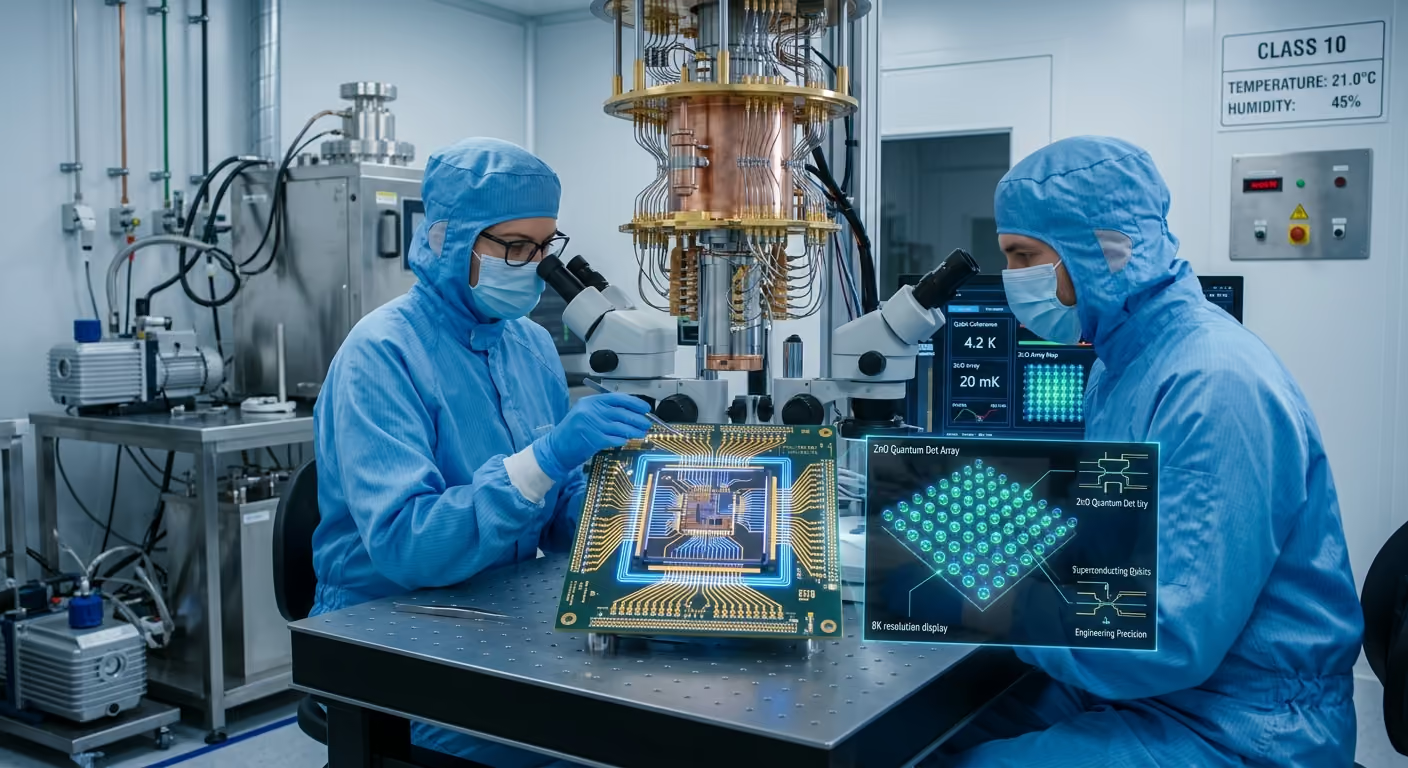
In a major scientific and commercial milestone, D-Wave Quantum Inc. has published a landmark peer-reviewed study in the journal Nature, showcasing a critical hardware breakthrough for quantum error correction. The company has successfully demonstrated a dual-rail qubit gate, which represents a massive leap forward in the global race to build practical, fault-tolerant, gate-model quantum computers.
This breakthrough is expected to radically accelerate the timeline for commercial quantum hardware. By implementing dual-rail qubits, researchers can suppress physical error rates directly at the hardware level, laying a more resilient foundation for complex quantum algorithms. The peer-reviewed validation has already triggered intense interest from Wall Street and deep-tech investors, positioning D-Wave as a highly versatile competitor in both annealing and gate-model architectures.
NTT and OptQC Target One Million Qubits
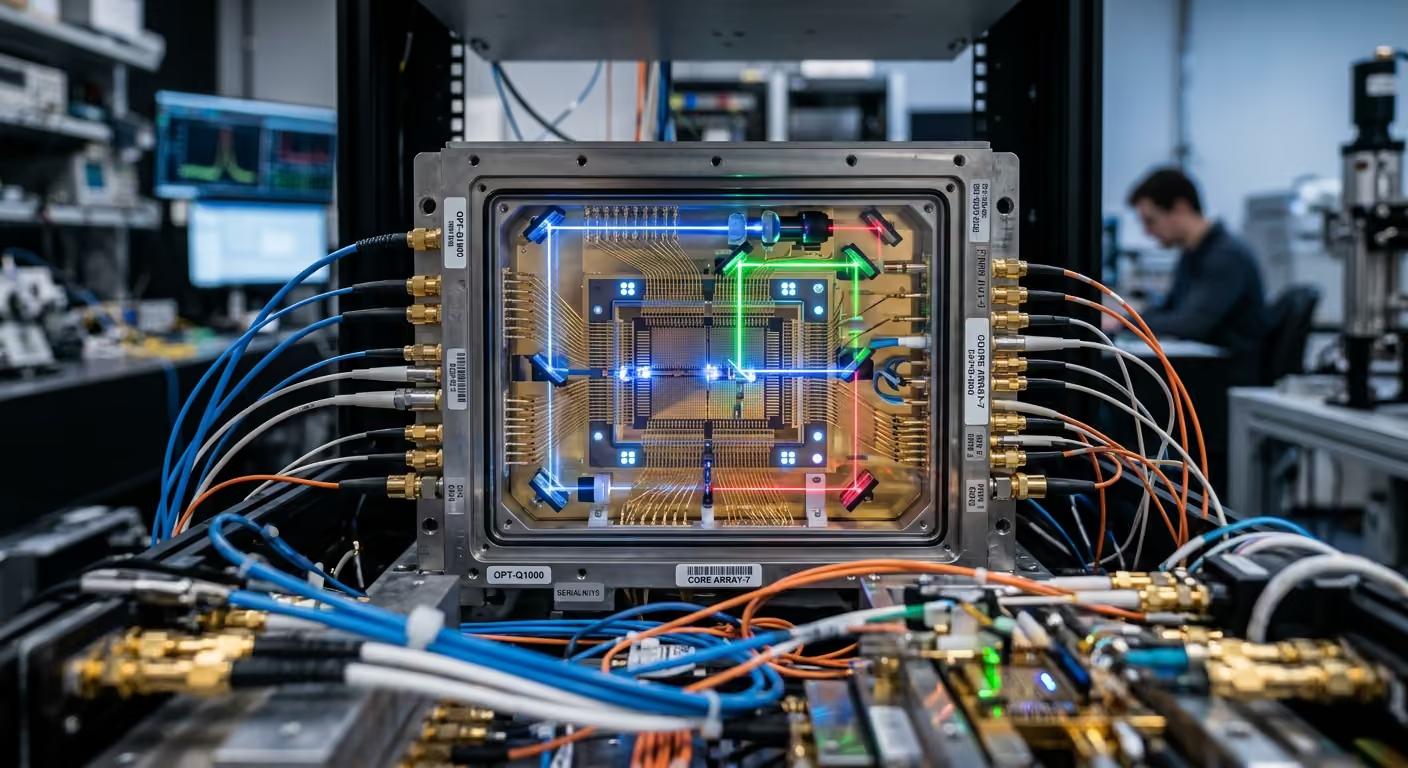
Simultaneously, the optical quantum computing sector has received a monumental boost in East Asia. Telecommunications giant NTT has entered into a strategic capital and business alliance with OptQC, a high-profile startup backed by the University of Tokyo. This newly solidified partnership has established an ambitious roadmap: to commercialize a million-qubit-class optical quantum computer by the year 2030.
Unlike traditional superconducting systems that require massive dilution refrigerators, optical quantum systems utilize photons to process information, offering a distinct pathway to room-temperature operations and seamless integration with existing fiber-optic telecommunications networks. The NTT and OptQC alliance plans to leverage NTT's advanced optoelectronics technology to build highly scalable, fault-tolerant quantum hardware capable of running massive industrial simulations.
Enterprise Adaptations and Global Funding Floods
- Silicon Spin Commercialization: In a strategic play to dominate the solid-state qubit market, IBM has officially acquired HRL Laboratories (HRL). This acquisition is specifically designed to accelerate IBM's development of silicon spin quantum computers, combining HRL's semiconductor fabrication expertise with IBM's commercial quantum software ecosystem.
- Quantum Optimization Funding: Japanese software startup JIJ has successfully raised 5.2 million dollars in a fresh funding round led by Global Brain, with participation from Mitsubishi Electric's ME Innovation Fund. JIJ plans to use the capital to scale its mathematical optimization middleware, which allows enterprises to run complex logistics and financial algorithms across different quantum and classical backends.
- Quantum Logistics in Action: IQM Quantum Computers, in partnership with German railway operator Deutsche Bahn, has successfully demonstrated a quantum algorithm for real-time railway scheduling. Crucially, the algorithm was tested on actual operational data, proving that quantum systems can already optimize transit logistics in real-world scenarios.
- Financial R&D: Amazon Web Services (AWS) has announced a new research collaboration with JPMorganChase. The joint initiative will focus on developing advanced quantum algorithms for portfolio optimization and risk assessment, utilizing AWS's Braket cloud platform.
National Sovereignty and Tech Security
As the power of quantum computing nears critical thresholds, governments are moving to protect their domestic technology pipelines. Israel has officially launched a national quantum computer tender as a core pillar of its broader AI sovereignty strategy. The government aims to establish a localized, highly secure quantum infrastructure to ensure national security and scientific independence.
Meanwhile, in the United States, a new White House Executive Order has designated the Federal Bureau of Investigation (FBI) as the lead agency responsible for protecting domestic quantum technologies from foreign espionage and intellectual property theft, signaling that quantum hardware has officially transitioned from an academic pursuit to critical national infrastructure.
The Bottom Line
- Error Correction Realized: D-Wave's dual-rail qubit breakthrough, published in Nature, brings fault-tolerant quantum computing closer to commercial reality.
- The Optical Race Is On: NTT and OptQC's alliance establishes a massive milestone of targeting one million optical qubits by 2030, bypassing cryogenic bottlenecks.
- Strategic Acquisitions: IBM's acquisition of HRL highlights the growing enterprise focus on silicon spin qubits as a highly scalable hardware architecture.
- Quantum Fun Fact: Optical quantum computing uses photons, the very same particles of light that travel through standard fiber-optic cables, meaning future optical quantum computers could theoretically be linked across global networks without needing complex signal conversion.
Stay Connected for Weekly Quantum Intelligence
Follow us to get the latest breaking quantum computing reports and technical analysis delivered weekly.
Aibots Sdn Bhd | [Beyond Future]